What 2025 Really Taught Logistics Operators + How to Prepare for 2026
CartonCloud CEO Shaun Hagen and CPO Vincent Fletcher review 2025 industry and in-platform changes, while previewing new features in the CartonCloud roadmap for 2026.
Published:
December 19, 2025

TABLE OF CONTENTS
“The best operators weren’t necessarily the ones who guessed right; they were the ones who were able to replan and respond quickly without breaking the floor.” — Shaun Hagen, CartonCloud CEO.
2025 will go down as one of the most transformative years the logistics industry has seen in the last decade. A perfect storm of tariff changes, global trade reshuffling, supply chain volatility, and explosive tech advancement pushed logistics operators to rethink, and rebuild how they work.
Through industry insights and millions of data points from the 600+ logistics businesses powered by CartonCloud, we’ve unpacked the biggest shifts redefining the way warehouses and transport operators plan, operate, and grow.
TL;DR: 2025 saw global tariffs spark significant supply chain changes for onshore and nearshore manufacturing, while AI and emerging technologies provided both an edge and a new platform for logistics operations. CartonCloud CEO Shaun Hagen and CPO Vincent Fletcher review 2025 industry and in-platform changes, while previewing new features in the CartonCloud roadmap for 2026.
Watch the full webinar on demand, “How CartonCloud Is Shaping Smarter Logistics in 2026”, with CartonCloud CEO Shaun Hagen and Co-founder & CPO Vincent Fletcher.
2025: A Year of Disruption, Innovation & Record Volumes
If there’s one word that defined logistics in 2025, it’s change.
Global supply chains were shaken — and reshaped.
Across multiple sectors, several forces converged to directly impact day-to-day operations:
- Nearshoring surged across North America as companies moved production closer to home.
- Major tariff changes early in the year introduced new cost pressures and rewired shipping routes almost overnight.
- Volatility returned in full force, placing resilience and flexibility back at the top of every logistics leader’s priority list.

In response, businesses began rethinking every part of their operation — from sourcing strategies and partner relationships, to the technology driving execution on the floor.
“The best operators weren’t necessarily the ones who guessed right; they were the ones who were able to replan and respond quickly without breaking the floor.” — Shaun Hagen, CartonCloud CEO
As conditions shifted, adaptability and resilience moved quickly from long-term aspirations to daily operational necessities.
“Resilience stopped being a buzzword and became a daily operating requirement for all types of operations across the supply chain.” — Shaun Hagen, CartonCloud CEO
At the same time, this shift created opportunity. In 2025, resilience became a competitive advantage — particularly as renewed e-commerce growth unlocked new pathways for operators ready to scale.
The Opportunity Shift: E-commerce Boom
In 2025, e-commerce became a dominant driver of demand across logistics. Peak periods grew stronger, order profiles became more diverse, and customer expectations continued to rise — reshaping how warehouses operated day to day.
“From a warehousing and logistics perspective, e-commerce now accounts for roughly a quarter of the total warehousing demand, and that has continued to grow year on year.” — Shaun Hagen, CartonCloud CEO
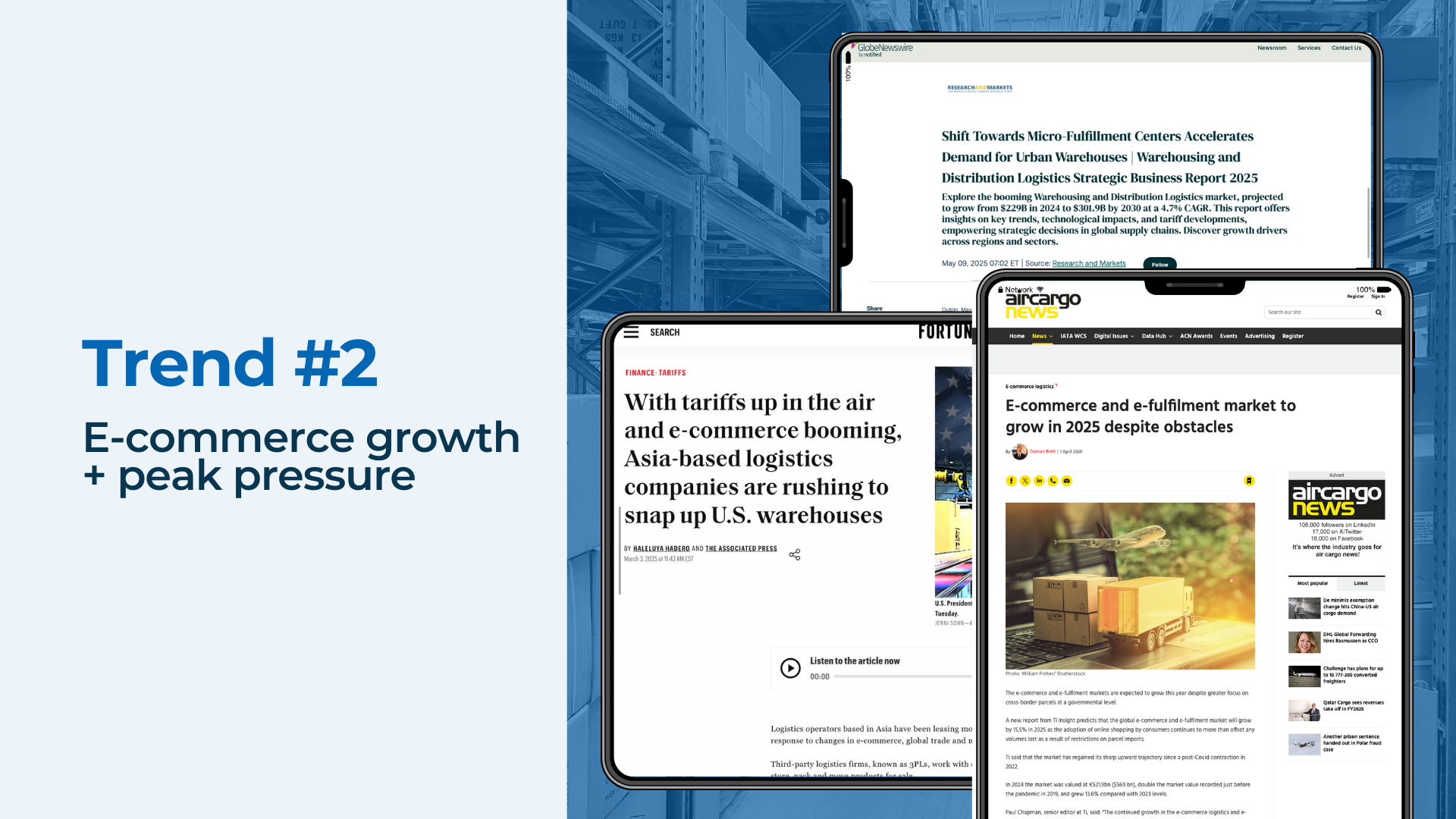
Operators who had already invested in flexible picking, packing, and fulfilment workflows were well-positioned to absorb this variance without sacrificing service — achieving faster pick and pack cycles, higher accuracy, and stronger customer communication at scale.
The data showed this wasn’t just about handling more volume, but about evolving how work gets done — and across CartonCloud, operators didn’t just keep up with demand, they did it efficiently.
In 2025, order volumes increased 24% year-on-year, with an even sharper rise in November (+33% YoY) as Black Friday and Cyber Monday drove peak demand for 3PLs.
“One of the really pleasing trends was that Wave Picking was up 68% year-on-year, which highlights that teams are standardizing workflows, batching and reducing chaos essentially to help scale throughput without scaling supervisors.” — Shaun Hagen, CartonCloud CEO
On top of that, Pick to Tote adoption highlighted real efficiency gains.
Pick to Tote usage increased 50% between June and November, right in the heart of peak season, helping to shave off seconds off every order.
Automation and AI became practical, everyday tools
Another standout theme from 2025 was how quickly automation and AI moved from experimentation to execution.
“At the start of the year, we were talking about speeding up search and basic tasks. Now we’re seeing autonomous agents embedded into workflows.” — Shaun Hagen, CartonCloud CEO

According to the Atlassian AI Collaboration Index (2025), 90% of Australians utilise AI at least once a week, saving an average of 78 minutes daily. In comparison, 86% of Americans engage with AI, saving around 64 minutes each day.
This shift made one thing clear: AI delivered the most value when it was embedded directly into daily workflows. By reducing manual steps, re-keying, and decision lag, AI helped logistics teams move faster and operate with greater consistency — without adding complexity.
CartonCloud 2025 in Review
In response to the shifts across the logistics industry in 2025, CartonCloud focused product development on helping operators execute e-commerce fulfilment at scale. The result was a series of major releases centred around the e-commerce suite, designed to support higher volumes, more SKUs, and peak-driven demand.
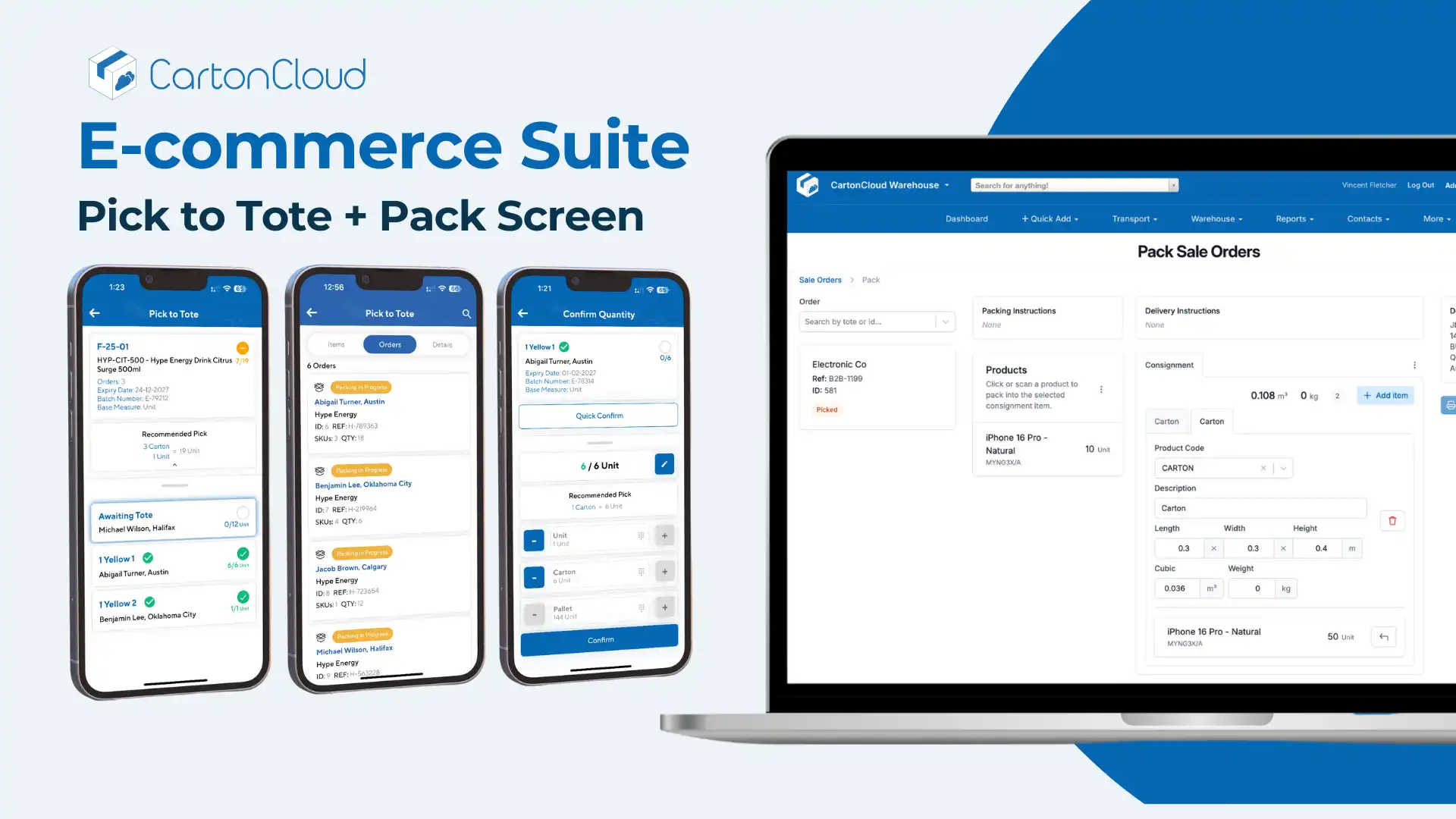
“Pick to Tote was really the first big piece of the e-commerce workflow. It allows teams to pick a large number of orders at the same time and pre-sort them straight into different totes, which is critical when volumes ramp up.” — Vincent Fletcher, CartonCloud Co-founder & CPO
That release laid the foundation for a broader evolution of the fulfilment workflow across the second half of the year.
“From there, we followed up with the Pack Screen, the new Picked status, and Warehouse Fulfilments — all building on the core warehousing system to support more structured, scalable execution.” — Vincent Fletcher, CartonCloud Co-founder & CPO
While the e-commerce suite was a major focus, 2025 also saw a wide range of releases across the platform to remove friction, improve accuracy, and support growing operational complexity across warehouse and transport workflows.
Additional 2025 product releases included:
- Warehouse Zones
- Pallet Wrapped
- New Consignment Items UI
- Mobile Wave Pick Generation
- Custom General Ledger Mapping
- Photos and Documents on Sale Orders
- Optional SSCC
- Login with Microsoft / Google
- ZPL Editor / Previewer
- Backorder Management & Advanced Backordering
- Product Tags
- Lots of new Document Template placeholders
- Shopify support for backordering
- Require Photos on POD
- Latest Releases surfaced on the Dashboard
- US Duty Support
- POD V2
- Item-level Scanning
- Directly Shippable Products
Item-level Scanning: A Standout TMS Enhancement
A key highlight for CartonCloud’s TMS in 2025 was Item-level Scanning, improving delivery accuracy, visibility, and proof of execution at the item level for teams.

This included:
- Item-level label generation with new label templates that print directly to ZPL printers or export to PDF, with automatic label numbering and additional item-level placeholders.
- Mobile item scanning, allowing drivers to scan multiple item barcodes in real time using their device camera directly within the POD screen.
- Scan history visibility with a complete scan history available in a dedicated tab on each consignment.
Powerful Features You Helped Create
In 2025, the CartonCloud team spent more time where it matters most: on the warehouse floor. Being on-site let us see how features were actually used day to day — and where small tweaks could make them work even better for the way you work.
“We took a lot of our team out on site visits and walked through the processes customers were actually using. It was about seeing firsthand what they were doing, where the problems were, and how we could make the product work much better for them.” — Vincent Fletcher, CartonCloud Co-founder & CPO
Across the year, product decisions were shaped by direct input from more than 600 customers — through everyday conversations, structured feedback in the Ideas Portal, and extensive on-site visits. Nearly half of the CartonCloud team spent time inside live warehouse and transport operations, walking workflows step by step to understand real-world needs and requirements.
Working closely alongside our customers, this feedback directly informed the evolution of key e-commerce workflows. One example was a change to the Sales Order flow, including the introduction of a new status to better reflect how teams stage, pick, and progress work during high-volume periods.
These updates were delivered ahead of peak season, giving teams time to adopt them before volumes surged — ensuring workflows were ready when it mattered most.
Looking ahead in 2026: CartonCloud’s Product Roadmap
Now, let’s take a peek at what’s to come in 2026 in CartonCloud.
“We really do see 2026 as a chance to get back on the front foot. Whether you're a 3PL or a scaling brand — the front foot really means saying yes to growth [and] scaling capacity through workflow and automation first, not just headcount.
You see those themes really prominent in what we're trying to deliver in the first half of 2026; we want our users to be adopting the tech that buys them time back, improves accuracy and unlocks capacity in their operation.” — Shaun Hagen, CartonCloud CEO
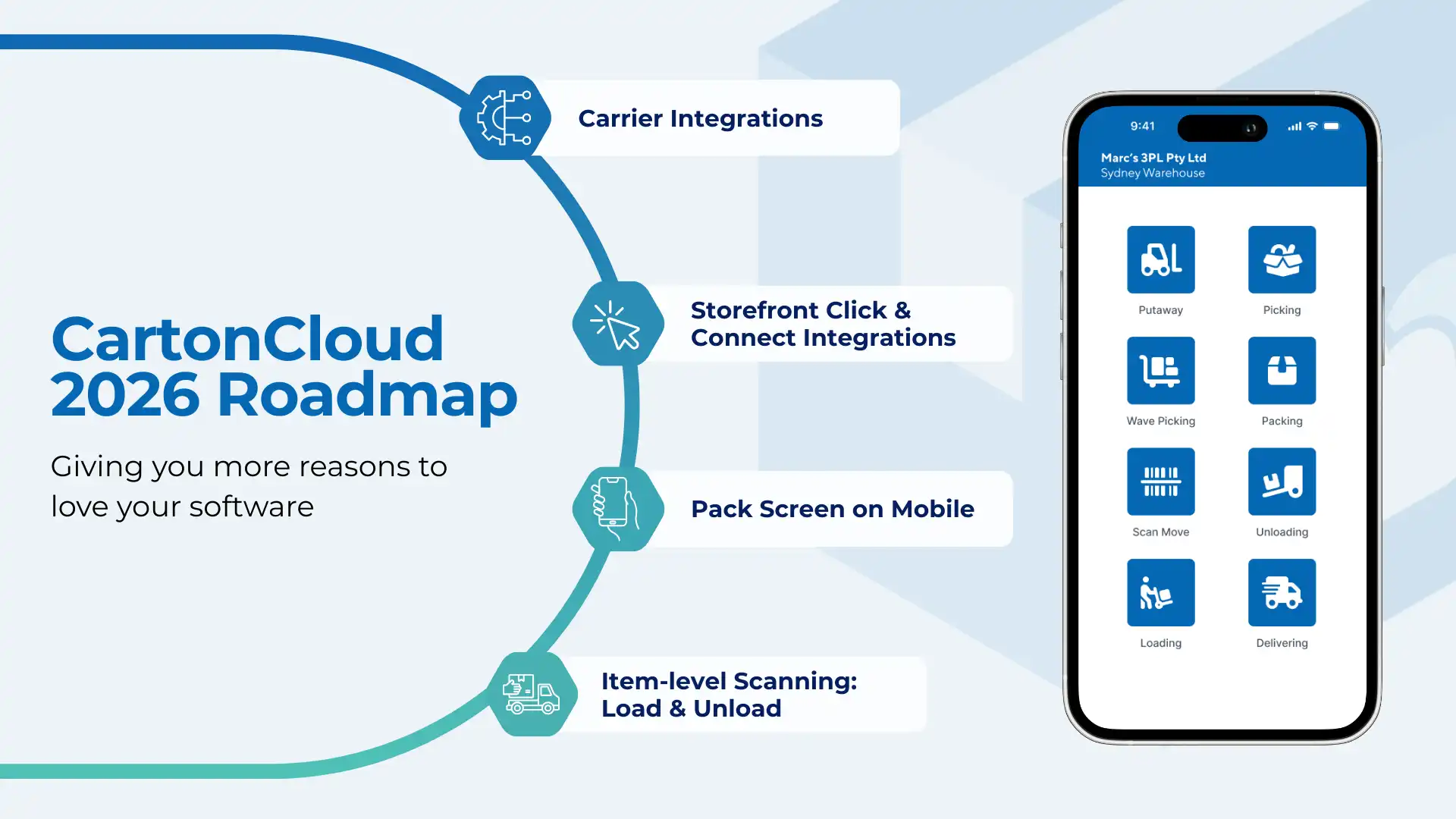
Deeper integrations across the logistics stack.
Integrations will continue to be a major focus in 2026, as operators look to eliminate re-keying, reduce errors, and keep data flowing seamlessly between systems, including integrations for major carriers, as well as Click and Connect integrations for storefronts.
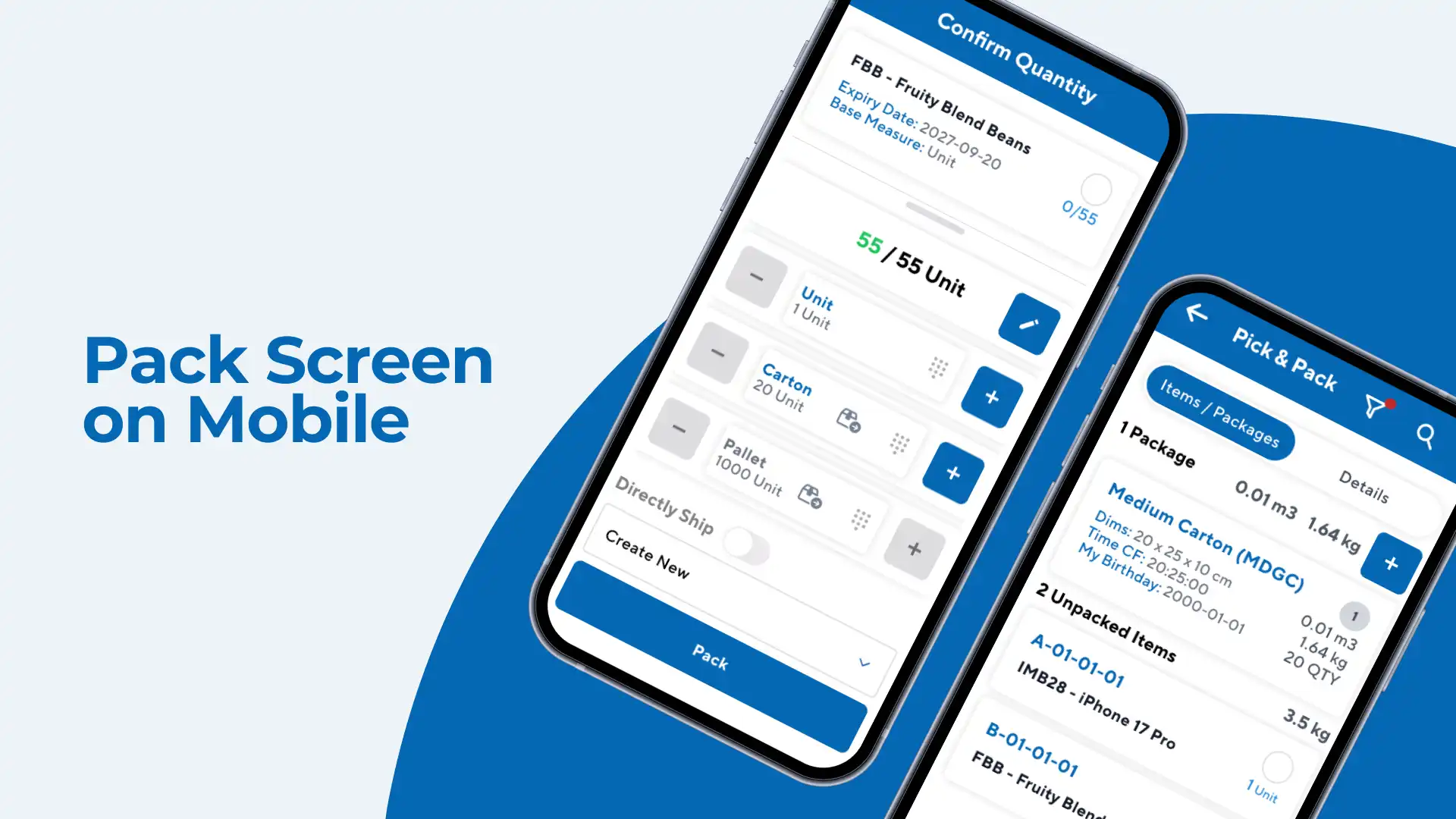
Pack Screen on mobile: extending execution to the floor.
Following strong adoption of the Pack Screen in 2025, one of the key enhancements on the roadmap is bringing the Pack Screen experience to mobile devices!
This will allow packing teams to:
- Pack orders directly from mobile devices.
- Maintain accuracy and structure away from fixed packing stations.
- Support more flexible packing setups during peak periods.
Item-level scanning: Load & Unload.
Item-level scanning will continue to expand beyond proof of delivery, with planned enhancements focused on load and unload events.
This next phase is designed to:
- Improve item-level accuracy during loading and unloading.
- Provide clearer visibility of what moved, when, and where.
- Reduce disputes, missed items, and reconciliation work.

Where Logistics Goes From Here
The logistics industry is evolving faster than ever — but the opportunities have never been stronger. Businesses embracing automation, AI-driven insights, connected workflows, and real-time data are already setting the pace for 2026.
Whether you’re a 3PL, warehouse operator, transport provider, or logistics leader, the steps you take now will define your competitiveness in the year ahead.
Explore the resource hub
Tips, tools, downloadable guides and stories from logistics teams who are working smarter.
This Week in Logistics: A Cost Rule Peak — Canada's Tariffs Go Live, FedEx Guarantees Your Duties, and Peak Season Surcharges Land
What's the Best WMS for Small 3PLs That Need an Easy Setup?

CartonCloud vs Extensiv: Which Platform Delivers More for 3PLs?
Get a Free, Honest Read on Your Operation, in About Two Minutes

CartonCloud’s Commitment to Security: SOC 2 Type 2 Audit Complete
How to Implement a WMS in Your Small 3PL Business: A Practical Guide
.webp)
This Week in Logistics: Multiple Warehouses, Multiple States, One Standard — How HD Warehousing Does It, With Special Guest Chad Hildebrandt, Owner & COO
August 2026: New Feature Round-Up
Warehouse Software for Cold Storage, Food, and Temperature-Controlled Logistics
This Week in Logistics: Season 2 Returns — US-Canada Tariffs, Oil Volatility, and Panama Canal Cuts All at Once
.webp)
How Do You Know You've Outgrown Basic Warehouse Systems? 7 Signs for Growing US 3PLs
.webp)
CartonCloud Named a 2026 "Great Supply Chain Partner" by SupplyChainBrain
.webp)
Dock Management: How We Built Visibility Into Every Delivery
.webp)
July 2026 — New Feature Round-up

What US 3PL Operators Really Say About Switching From Slow, Complex WMS Alternatives
CartonCloud vs Competitors: An Honest Comparison from an Implementation Specialist
.webp)
Running Multiple Sites from One WMS System: How HD Warehousing Scaled Without the Complexity
.webp)
This Week in Logistics: The Operator Playbook
Deposco Alternatives: What Growing 3PLs Should Consider
CartonCloud Feature Spotlight: April-June 2026