The Enterprise Logistics Equation: Turning Operational Integrity into Quantifiable ROI
For enterprise logistics leaders, ROI is often revealed in moments of pressure — when volumes spike, networks expand, or customer expectations change faster than systems do. The real question isn’t whether costs can be trimmed, but whether the operation can continue to perform predictably as complexity increases.
Published:
February 18, 2026

TABLE OF CONTENTS
For enterprise logistics leaders, ROI is often revealed in moments of pressure — when volumes spike, networks expand, or customer expectations change faster than systems do. The real question isn’t whether costs can be trimmed, but whether the operation can continue to perform predictably as complexity increases.
In conversations with COOs, GMs, and CFOs across large 3PLs and major brands, one pattern consistently emerges: the strongest returns don’t come from asking teams to work harder. They come from removing friction… the manual steps, workarounds, and system gaps that quietly inflate cost-to-serve as a business scales.
This is where operational integrity becomes a competitive advantage. When systems enforce standardised processes, data is trusted, and execution is aligned across warehouse and transport, logistics shifts from a cost centre to a strategic lever. ROI becomes measurable, repeatable, and crucially, it becomes visible at the board level.
TL;DR: Below, I’ll unpack the three operational levers that matter most to logistics mid-market enterprises and how integrated warehouse and transport systems turn operational discipline into measurable ROI.
The Cost-to-Serve Transformation
At enterprise scale, operational efficiency stops being an operational concern and becomes a strategic lever. For many mid-market and enterprise logistics operators, that lever is being quietly undermined by what we often call process debt.
These are the manual steps that once made sense: spreadsheets passed between teams, paper-based pick slips, re-keying data from one system into another. Individually, they feel manageable. Collectively, they add a hidden “manual tax” to every order that moves through the business.
When volume increases, this tax compounds.
- True ROI begins when those processes are compressed.
- By capturing data once, at the point of activity, and allowing the system to drive the workflow end-to-end, enterprises can convert administrative effort into productive capacity.
- Instead of hiring more people to keep up, teams ship more with the resources they already have.
Our software originated as an in-house solution to solve this exact kind of friction, and has scaled to the platform we now have, with this core goal at the center of what we do — removing friction, and allowing operations to scale with agility and speed.
“What drives cost-to-serve up in most logistics businesses isn’t labour itself — it’s labour spent compensating for poor systems. When people are re-keying data, chasing errors, or working around gaps between warehouse and transport, you’re effectively paying twice for the same work.
By capturing information once, at the source, and letting the system carry it all the way through the operation, cost-to-serve stops rising with volume.” Vincent Fletcher, Co-founder and Chief Product Officer at CartonCloud.
Precision-Led Profitability: Accuracy, Waste, & Control
A 1% inventory error might sound small on paper, but at scale it rarely stays small. It shows up as expired stock, unplanned write-offs, customer disputes, or a growing lack of confidence in reporting.
Over time, these issues don’t just create operational noise — they quietly erode profitability and decision-making in ways that are difficult to trace back to a single cause.
Many operations still rely on tribal knowledge to keep things running smoothly — that one person who knows where all the stock is stored, or how adjustments are usually handled. While this may work in the short term, it introduces operational risk and makes accuracy dependent on individuals rather than systems.
Enterprise-grade ROI comes from shifting to system-led execution. Real-time, scan-based validation ensures that accuracy is built into everyday workflows, not checked after the fact. Write-ons and write-offs become controlled, auditable processes, and inventory data can be trusted by finance, operations, and leadership alike.
At CartonCloud, accuracy isn’t treated as a downstream check — it’s embedded into every step of the fulfilment process.
“At scale, accuracy can’t be something you check later — it has to be enforced as work happens. Barcode scanning is what closes that gap.” — Vincent Fletcher, Co-founder and Chief Product Officer at CartonCloud.
Using mobile barcode scanning, teams can validate stock as it’s received, confirm locations during putaway, and verify every pick and pack in real time. The system provides immediate feedback at each touchpoint, ensuring top-notch accuracy.
When accuracy becomes a byproduct of the system, waste reduces naturally, reporting becomes reliable, and profitability becomes far more predictable.
Architecting for Peak Performance
Peak periods have a way of exposing weak systems.
Whether it’s seasonal demand, promotional surges, or rapid expansion into new regions, enterprise brands need operations that can scale volumes without breaking. Here, the challenge isn’t just about handling more volume; it’s doing so without delays or exponential increases in overhead.
This is where metrics like time-to-value and scaling velocity matter. You need to know your system can stand up where it counts.
- How quickly can a new warehouse go live?
- How easily can workflows be standardised across multiple sites?
- How seamlessly does data flow between ERP, warehouse, and transport systems?
Scalability, in its truest sense, means being able to double volume without doubling headcount. It means adding new locations without multiplying IT complexity. And it means maintaining real-time visibility across every site, even as operations grow more distributed.
Take AustraCold, a rapidly growing temperature-controlled logistics provider based in Melbourne Australia who use CartonCloud to manage their 5 warehouse locations and a fleet of 60 vehicles servicing Victoria and beyond.
As the business scaled, time-to-value and scaling velocity became critical — ensuring every site, vehicle, and workflow remained connected and visible within an integrated system.
“We’ve actually grown our business in volume over the last three years, but we haven’t had to employ any extra staff.” — Kevin Forte, General Manager of Operations at AustraCold.
How? By running their multi-site operation through CartonCloud’s integrated WMS + TMS platform, the team could make real-time decisions about where stock should be held, which site should fulfil each order, and when product should be moved between locations — without switching systems or losing visibility.
“[CartonCloud allows] us to deliver the product in the shortest possible time, and most cost-effective way. We can use the platform to decide which of our sites to use, or to move product between sites without switching between warehouses in the system. We now find ourselves dealing with some of the biggest companies in Australia, in terms of what we can offer them as a service.” — Kevin Forte, General Manager of Operations at AustraCold.
For enterprise logistics teams, this is what scalable architecture looks like in practice: growth without chaos, complexity without confusion, and systems that support ambition rather than limiting it.
From Legacy Operations to Enterprise SaaS Outcomes
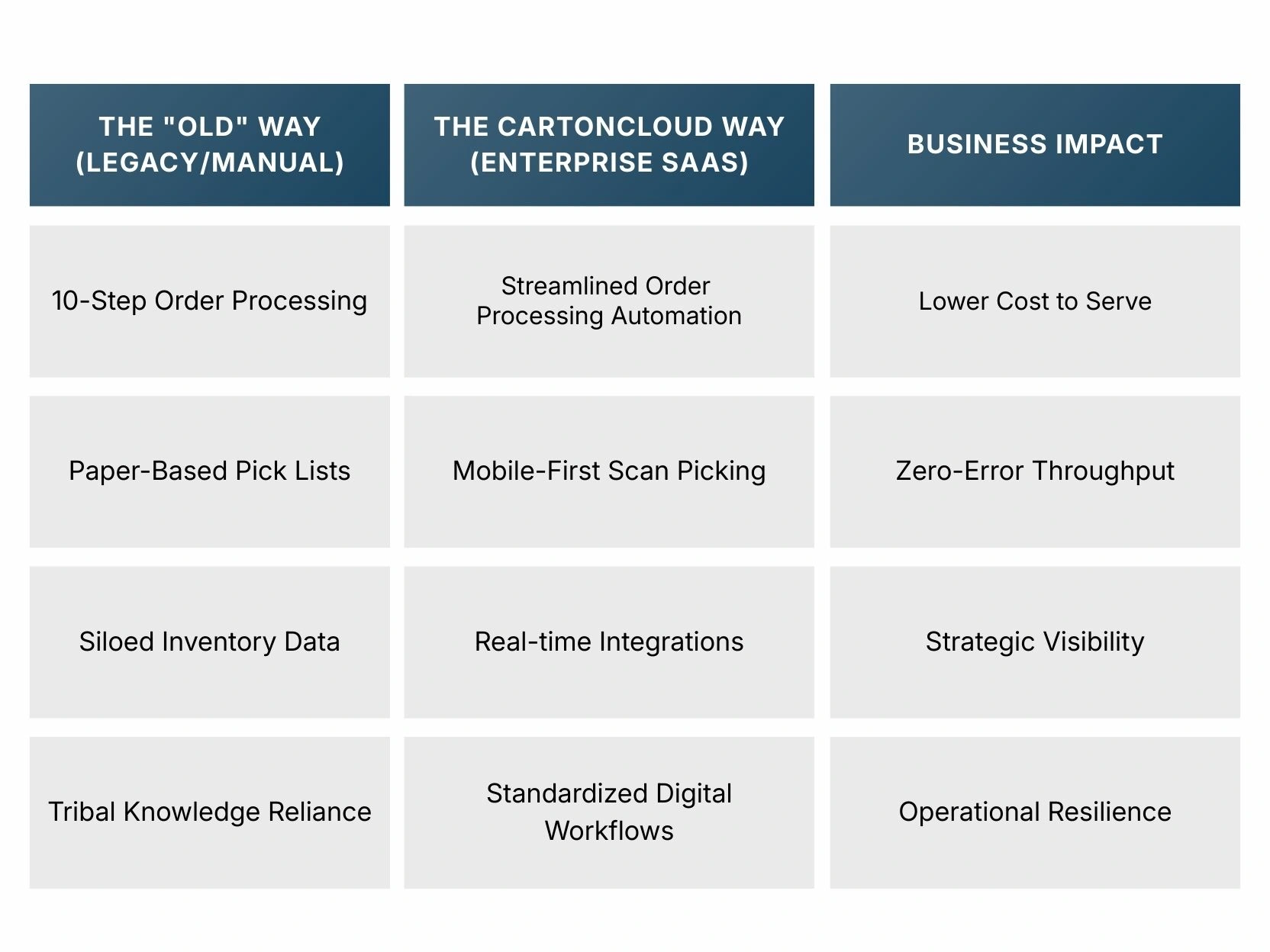
When you step back, the difference between legacy operations and modern enterprise platforms becomes clear.
Legacy environments are often defined by fragmented data, manual handoffs, and reliance on experience rather than process. Enterprise SaaS platforms, by contrast, standardise execution, surface real-time insight, and create operational resilience that doesn’t depend on individual knowledge.
The result is not just operational improvement, but a tangible shift in business outcomes — lower cost-to-serve, higher throughput accuracy, and leadership teams who can make decisions based on trusted data.
Visualizing the ROI: The Enterprise Framework
Key Takeaways
- Enterprise ROI is driven by operational integrity, not incremental cost-cutting. The biggest returns come from removing process debt, enforcing system-led workflows, and converting manual effort into scalable capacity — making ROI predictable, repeatable, and defensible at board level.
- Accuracy protects margin when it’s built into the system, not reliant on people. Real-time, scan-based execution eliminates tribal knowledge, reduces waste and write-offs, and creates trusted data that finance, operations, and leadership can rely on.
- True scalability means growing volume without growing complexity or headcount. Integrated WMS + TMS platforms enable faster time-to-value, multi-site visibility, and peak-ready operations — allowing enterprises to expand confidently without breaking their cost-to-serve model.
Turn operational integrity into defensible ROI
If you’re looking to remove process debt, build system-led execution across warehouse and transport, and create predictable returns your leadership team can stand behind, let’s talk.
Book a CartonCloud demo to see how our integrated WMS + TMS can deliver measurable ROI for your business.
Explore the resource hub
Tips, tools, downloadable guides and stories from logistics teams who are working smarter.
Deposco Alternatives: What Growing 3PLs Should Consider
What We Heard at B2B World APAC: Large Brands Want Delivery Visibility, Not Just Warehouse Visibility
The Fastest WMS to Implement for E-Commerce Fulfillment 3PLs in the USA
This Week in Logistics: A Cost Rule Peak — Canada's Tariffs Go Live, FedEx Guarantees Your Duties, and Peak Season Surcharges Land

What's the Best WMS for Small 3PLs That Need an Easy Setup?

CartonCloud vs Extensiv: Which Platform Delivers More for 3PLs?

Get a Free, Honest Read on Your Operation, in About Two Minutes

CartonCloud’s Commitment to Security: SOC 2 Type 2 Audit Complete

How to Implement a WMS in Your Small 3PL Business: A Practical Guide
.webp)
This Week in Logistics: Multiple Warehouses, Multiple States, One Standard — How HD Warehousing Does It, With Special Guest Chad Hildebrandt, Owner & COO
August 2026: New Feature Round-Up
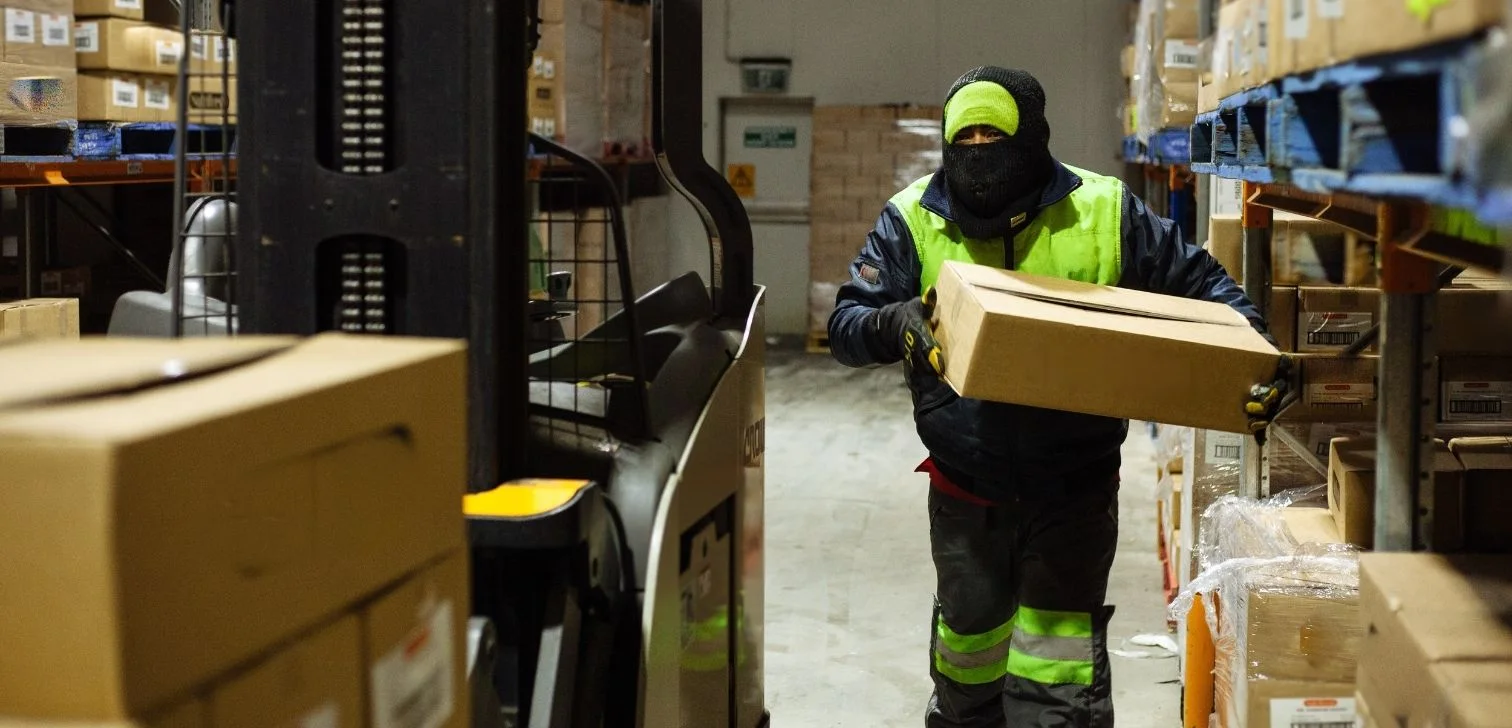
Warehouse Software for Cold Storage, Food, and Temperature-Controlled Logistics
This Week in Logistics: Season 2 Returns — US-Canada Tariffs, Oil Volatility, and Panama Canal Cuts All at Once
.webp)
How Do You Know You've Outgrown Basic Warehouse Systems? 7 Signs for Growing US 3PLs
.webp)
CartonCloud Named a 2026 "Great Supply Chain Partner" by SupplyChainBrain
.webp)
Dock Management: How We Built Visibility Into Every Delivery
.webp)
July 2026 — New Feature Round-up

What US 3PL Operators Really Say About Switching From Slow, Complex WMS Alternatives

CartonCloud vs Competitors: An Honest Comparison from an Implementation Specialist
.webp)
Running Multiple Sites from One WMS System: How HD Warehousing Scaled Without the Complexity