This Week in Logistics: Purpose. People. Proof. Inside Hone's Social Enterprise 3PL Model
Sharon Prasad, Operations Manager at Hone, makes the case that building an operation around supported employment doesn't mean compromising on performance — it means being encouraged to run a better one.
Published:
June 25, 2026
TABLE OF CONTENTS
Hone — formerly Hoxton Industries — is a Southwest Sydney social enterprise that has been delivering supported employment since 1969. Today it runs destruction, packaging, point of sale, returns and earn, and 3PL across multiple sites, employing around 200 people with disabilities. Its clients include Vision Australia and Medtronic. They do not partner with Hone out of charity. They partner because Hone delivers on time, handles errors honestly, and fixes problems fast.
— TL;DR — The short version
Season one finale of This Week in Logistics. A different kind of episode.
- Purpose built. Hone is a Southwest Sydney social enterprise that has operated since 1969, growing from a local bike repair program into a multi-service 3PL with its own consumer brand, Lumiere.
- Constraint creates discipline. Running a workforce with additional support needs forces the kind of clarity and process discipline that most operations aspire to.
- Performance, not charity. Major clients choose Hone because of their on-time delivery, accurate orders, and radical transparency when things go wrong.
- Supported employment produces originals. Lumiere — a candle and home fragrance brand made entirely by Hone's people — is proof that supported employment can produce something original, not just services.
- It is a commercial decision. Partnering with a social enterprise is a commercial decision. You get reliability, commitment, and people who genuinely want to be there.
- Build around the people doing the work. The best operations are the ones built around the people doing the work — not the other way around.
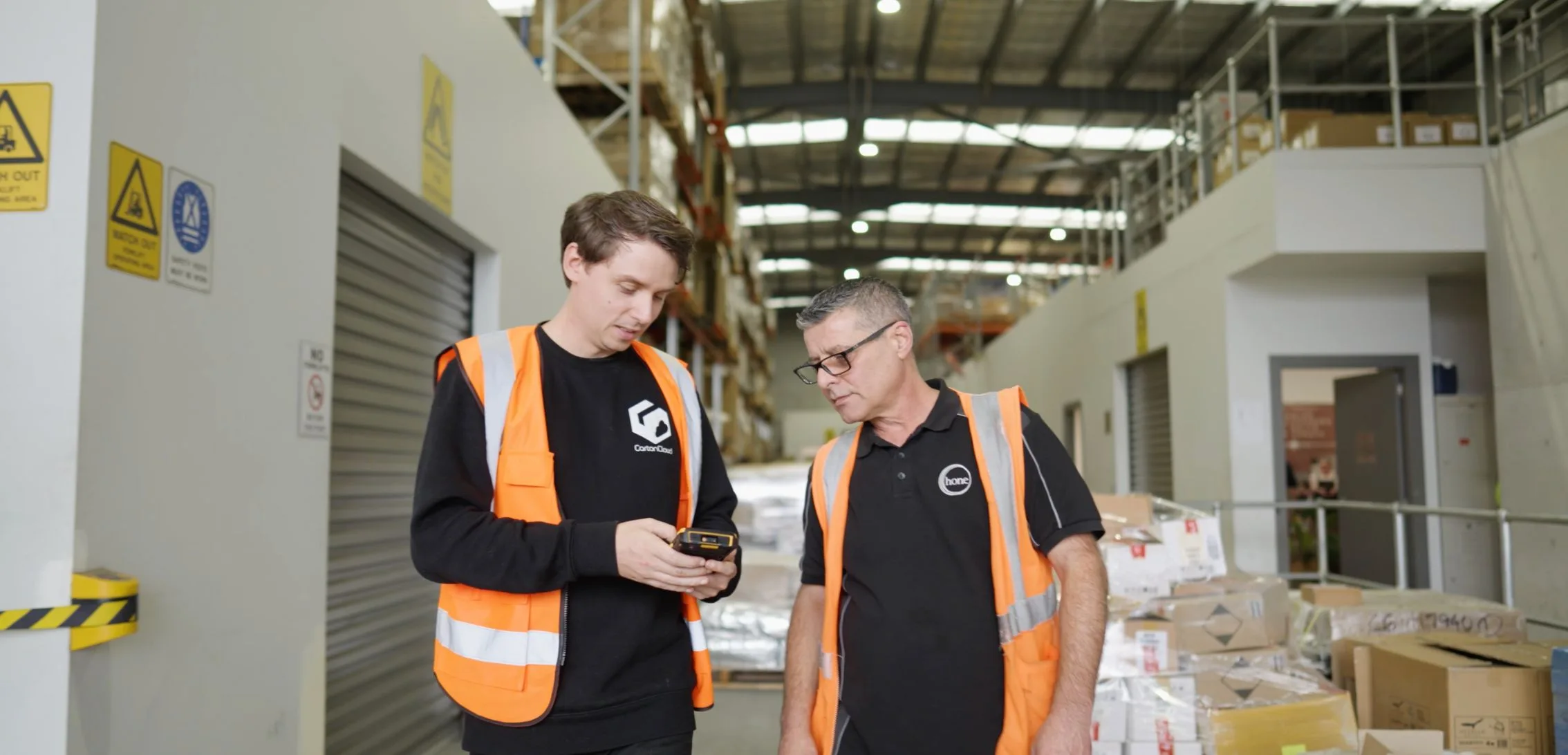
I'm Shaun Hagen, CEO of CartonCloud and host of This Week in Logistics — a weekly podcast and video series covering the market updates, operator stories, and ideas shaping how freight and warehousing actually works. I wanted to close out season one with something bigger than a market update, and Sharon Prasad, Operations Manager at Hone, gave us exactly that. Hone has been delivering supported employment in Southwest Sydney since 1969 — and Sharon's perspective on operations, culture, and purpose is one of the most honest conversations I've had on the show.
Season one of This Week in Logistics ends where the best logistics conversations always end up: not on the technology or the market, but on the people. This episode is a different kind of conversation.
Sharon Prasad has run operations at Hone long enough to have watched the business grow from a local community program into something few outsiders would have predicted: a multi-service 3PL that competes for and wins major contracts, a candle and home fragrance brand made entirely by the people working there, and a workforce of around 200 supported employees operating across multiple sites in Southwest Sydney and Victoria.
The question running through this conversation is not whether a purpose-led operation can perform. Hone has answered that. The more useful question is what operators everywhere can learn from the discipline that purpose demands.
From bike repairs to multi-service 3PL: how Hone grew into what it is today
Hone started with a simple instinct: find meaningful work for the people in the community. Bike repairs came first. From there, the business moved into production, packaging, point of sale, destruction, returns and earn, and eventually 3PL.
Sharon describes the logic behind each step the same way: growth followed purpose, not the other way around.
"Each step we've had has been driven by a simple question: where can we find more meaningful work for our people?" — Sharon Prasad, Operations Manager, Hone.
That question produced Lumiere — Hone's candle and home fragrance brand, not as a side project, but as a place where people could feel part of something bigger. It is made entirely by Hone's people, from production through to marketing at pop-up stores.
Sharon says Lumiere changes how the community sees Hone entirely. Not just a service provider. A manufacturer, a brand, an employer. A business that produces things people actively seek out.
For operators who have wondered what diversification actually looks like inside a purpose-led operation, Lumiere is the clearest answer in this conversation. It did not come from a growth strategy or a market gap analysis. It came from looking at what the people already had — and building something around it. That is a different starting point than most businesses use, and it produces a meaningful point of difference.
Why clarity + structure are not optional — + why that makes Hone a better operator
One of the sharpest observations in this conversation is also the most transferable.
Sharon is direct: the businesses that struggle — in any sector, not just supported employment — are the ones where nobody really knows what the processes are. Hone does not have that luxury. When your workforce has additional support needs, ambiguity is not a management style you can afford.
"Our workplace thrives on structure and clarity. Knowing what they're doing today, knowing what is expected of them, knowing where to go if something changes — these things make us a better operator and it forces us to also look at our processes, our workflows, and what good actually looks like for Hone." — Sharon Prasad, Hone
The result is an operation that runs on the kind of process discipline most companies talk about in strategy sessions and then fail to implement on the floor. Clarity is not a nice-to-have at Hone. It is how the business functions. And it turns out it delivers better results.
For operators thinking about warehouse management and workflow design, this is worth sitting with. The question is not whether your team could benefit from cleaner processes. They could. The question is whether you have built a system that makes good process the default, not the exception.
How Hone wins + keeps major clients
Hone's client list includes Vision Australia and Medtronic. Sharon is clear about why those relationships exist and what maintains them.
"They partner with us because we deliver on time, we deliver accurately, and if anything goes wrong — which of course it sometimes does, like it does in any business — we're honest about it and we fix it fast." — Sharon Prasad, Hone
The transparency piece is deliberate. When something goes wrong, Hone does not manage the bad news quietly. They take responsibility immediately, communicate what happened, and tell the client what they are doing to fix it.
"A lot of businesses try to manage bad news quietly, but we don't do that. And I think that builds a level of trust that's very hard to find between organisations." — Sharon Prasad, Hone
This is not a customer service philosophy. It is an operations philosophy. The real-time visibility and communication discipline that Hone has built into its day-to-day is the same thing that keeps major clients renewing. They never have to wonder what is happening.
For 3PL providers reading this, the takeaway is straightforward: what Hone delivers for their clients is built on the same foundations every good operation runs on — clarity, accuracy, and honest communication. Sharon puts it simply: find the right way to get things done for each individual person based on their strengths. Which, she notes, is just good management.
What meaningful employment actually looks like for the people at Hone
Ask most operations managers what meaningful employment looks like and you'll get a framework. Sharon puts it thoughtfully:
"It means having somewhere to be, having somewhere to belong, and having somewhere to contribute. Knowing that the work you did today actually mattered — that it went out the door, landed somewhere, and someone actually used it." — Sharon Prasad, Hone
A lot of Hone's people come from situations where they were told — explicitly or implicitly — that they were not capable, and what Hone gives them is the opposite of that. The confidence that comes from doing a job well, from being part of a team, from having colleagues and a routine and a purpose, Sharon says, is not something you can put a dollar value on.
It also drives results.
This is the part of the conversation that is hardest to translate into a KPI dashboard. But I keep coming back to it: the operators who are going to be the most resilient — especially as large-scale fulfilment continues to reshape competitive expectations — are the ones who know what they do, focus on the customer relationship, and know how to match their people to their strengths.
Why partnering with a social enterprise is a commercial decision
Sharon is direct on this, and it is worth quoting directly because the framing matters:
"Partnering with a social enterprise is not charity. It's a commercial decision. You get reliability, you get commitment, you get people who genuinely want to be there and take great pride in their work. That's not something you can engineer through a KPI system. It's something you earn by creating an environment where people feel like they genuinely belong." — Sharon Prasad, Hone
Sharon's advice for those looking to partner with a social enterprise: start with an open mind and leave the assumptions at the door. What people can do with the right structure and the right support will always surprise you.
What makes it work is not goodwill — it is structure. Clear workflows, unambiguous expectations, and consistent communication are not accommodations built around a disability workforce. They are just how Hone runs. That structure is what gives people the confidence to do the job well, and it is what gives clients the confidence to keep coming back. The businesses that struggle, Sharon says, are the ones where nobody really knows what the processes are. Hone addresses that head on — and it turns out that standard makes every part of the operation better.
The hard parts that do not make the brochure
Sharon does not present an idealised version of running a social enterprise. She is honest about the parts that are genuinely difficult.
Funding can be inconsistent. Cost structures are more complex. Running a commercial business while advocating for workers who deserve the opportunity is a constant balancing act.
"There are days when the system does not make it easy. But it is not always clean, and it is always worth it." — Sharon Prasad, Hone
Running both at once — commercial performance and genuine advocacy — is what makes Hone's results mean something. Most operations optimise for one thing. Hone has spent over fifty years proving you do not have to choose.
What operators can take from this conversation
- Process clarity is a competitive advantage. Hone's workforce needs unambiguous workflows, clear expectations, and structured communication. Those are not concessions to complexity. They are what good operations look like. The benchmark Hone sets is one worth measuring against.
- Transparency builds the relationships that last. When something goes wrong, how you handle it is what clients remember. Hone does not manage bad news quietly. That honesty is a commercial differentiator.
- Purpose and performance are not in tension. Growth has followed purpose at Hone, not the other way around. That is a model worth considering.
- The best question is not "how do we do more with less?" It is "is this operation actually built around the people doing the work?"
FAQ
Q: What is Hone and what does the business do?
A: Hone — formerly Hoxton Industries — is a Southwest Sydney social enterprise that has operated since 1969. It employs around 200 supported employees across multiple sites and service lines including destruction, packaging, point of sale, returns and earn, and 3PL, as well as Lumiere, a candle and home fragrance brand made entirely by its people.
Q: Does running supported employment affect a social enterprise 3PL's operational performance?
A: Running supported employment in a social enterprise 3PL does not reduce operational performance — it demands a higher standard of process clarity and communication than most operations achieve. Hone wins and retains major clients on the basis of on-time delivery, accurate orders, and transparent communication when things go wrong.
Q: What is a social enterprise 3PL?
A: A social enterprise 3PL is a third-party logistics provider that operates as a commercial business while also delivering a social purpose — typically employment for people who face barriers in the mainstream workforce, such as people with disabilities. Clients use these providers because they deliver on logistics requirements, not as an act of charity.
Q: Why do major clients partner with social enterprise logistics providers?
A: Major clients partner with social enterprise logistics providers because of results. Hone's clients — including Vision Australia and Medtronic — stay because Hone delivers on time, handles orders accurately, and communicates immediately and honestly when problems arise. Reliability and trust are the commercial basis for those relationships.
Q: What should a logistics operator consider before partnering with a social enterprise or employing people with disabilities?
A: Start with an open mind and leave the assumptions at the door. The assumption that disability equals lower capability is wrong. What people can do with the right structure and the right support will consistently surprise you — and the commitment, pride, and reliability you get in return is not something most operations can replicate through a standard recruitment and KPI model.
Explore the resource hub
Tips, tools, downloadable guides and stories from logistics teams who are working smarter.
This Week in Logistics: A Cost Rule Peak — Canada's Tariffs Go Live, FedEx Guarantees Your Duties, and Peak Season Surcharges Land
What's the Best WMS for Small 3PLs That Need an Easy Setup?

CartonCloud vs Extensiv: Which Platform Delivers More for 3PLs?

Get a Free, Honest Read on Your Operation, in About Two Minutes

CartonCloud’s Commitment to Security: SOC 2 Type 2 Audit Complete
How to Implement a WMS in Your Small 3PL Business: A Practical Guide
.webp)
This Week in Logistics: Multiple Warehouses, Multiple States, One Standard — How HD Warehousing Does It, With Special Guest Chad Hildebrandt, Owner & COO
August 2026: New Feature Round-Up
Warehouse Software for Cold Storage, Food, and Temperature-Controlled Logistics
This Week in Logistics: Season 2 Returns — US-Canada Tariffs, Oil Volatility, and Panama Canal Cuts All at Once
.webp)
How Do You Know You've Outgrown Basic Warehouse Systems? 7 Signs for Growing US 3PLs
.webp)
CartonCloud Named a 2026 "Great Supply Chain Partner" by SupplyChainBrain
.webp)
Dock Management: How We Built Visibility Into Every Delivery
.webp)
July 2026 — New Feature Round-up

What US 3PL Operators Really Say About Switching From Slow, Complex WMS Alternatives
CartonCloud vs Competitors: An Honest Comparison from an Implementation Specialist
.webp)
Running Multiple Sites from One WMS System: How HD Warehousing Scaled Without the Complexity
.webp)
This Week in Logistics: The Operator Playbook
Deposco Alternatives: What Growing 3PLs Should Consider
CartonCloud Feature Spotlight: April-June 2026