This Week in Logistics: The Structural Pieces Are Clicking Into Place: FedEx Freight, Humanoid Robots, + What Oil Settling Actually Means
CartonCloud CEO Shaun Hagen covers two weeks of structural shifts — FedEx Freight's independence, Figure AI's warehouse robot milestone, and what the latest oil data means for your pricing model right now.
Published:
June 11, 2026
TABLE OF CONTENTS
The biggest logistics developments of the last two weeks have been structural shifts — and they’re here to stay. FedEx Freight is now an independent public company. A humanoid robot sorted a quarter of a million packages in 200 continuous hours without a single hardware failure. And oil is settling into a volatile but gradually declining range, with the first credible government forecast of relief by Q4.
TL;DR — The short version
- FedEx Freight is now an independent public company. The largest LTL carrier in North America has its own board, salesforce, and tech roadmap — and it's targeting mid-market customers.
- Figure AI's robots sorted 249,560 packages in 200 hours with zero failures, closing the warehouse automation gap.
- Brent crude moved from $93 to $101 to $94–97 in a single fortnight on ceasefire-then-strike cycles.
- The EIA now forecasts Brent averaging $106 for June, dropping to $89 by Q4 if the Strait of Hormuz starts reopening.
- Australia's RTCCO is now seven weeks live and is now the operating reality, not an emergency response.
- Canada's PM publicly placed port logistics at the centre of trade strategy.
- C.H. Robinson's June update: effective capacity is tightening even though on paper, trucks are still available.
I'm Shaun Hagen, CEO of CartonCloud and host of our weekly podcast This Week In Logistics (TWIL). Each week, we take the headlines and trends shaping the logistics industry, to deliver your go-to for real operator news, and what you can do to stay ahead.
If you've been following the show, you'll know we've had three structural stories running in parallel for weeks — FedEx Freight's spinoff, the evolution of warehouse robotics, and the trajectory of oil prices. This fortnight, all three narratives hit a critical tipping point at the exact same time. FedEx Freight is officially an independent public company, a humanoid robot just completed a flawless 200-hour warehouse shift, and oil has settled into a range that offers the first credible path to relief.
These aren't just headlines—they are permanent structural shifts. Here is exactly what each one means for your operation.
Operator playbook for the next seven days
- Pay attention to the structural shifts. FedEx Freight independent, humanoid robots reaching warehouse-ready endurance levels, and Amazon Supply Chain Services entering procurement conversations — these are current realities, not future possibilities. Ask yourself: where do these shifts create opportunity for my business, and where do they create pressure?
- Model your fuel exposure for the range. The EIA's Q4 forecast of $89 Brent is the first credible sign of eventual relief — but relief is not the same as normal. Model against $85 and $105 for the remainder of 2026 and make sure your pricing adjusts in both directions.
- Focus on effective capacity and execution quality. In a market where usable capacity is tightening even though headline capacity looks stable, the operators who win are the ones with the best planning, the cleanest data, the fastest exception handling, and the clearest customer communication. Remember: process discipline first, technology second.
Let’s dive deeper into the headlines shaping logistics this week.
The structural landscape is being rebuilt in real time
FedEx Freight goes independent
FedEx Freight completed its separation from FedEx Corporation on 1 June and began trading on the New York Stock Exchange under ticker FDXF. On day one, it joined the S&P 500 and the Dow Jones Transportation Average.
This is a business with more than 26,000 service centre doors that has been operating inside a parcel company for 25 years. It is now competing purely on freight merit — with its own board, its own salesforce, and its own technology roadmap. They have been cutting hundreds of applications from their IT stack, simplifying the customer experience, and targeting mid-market customers specifically.
That is a direct competitive signal to every transport business that touches less-than-truckload freight. We have been tracking this on the show since This Week in Logistics Episode 8. It has now happened.
Humanoid robots reach warehouse-ready endurance
An endurance test for Figure AI’s F.03 humanoid robots in a warehouse environment vastly exceeded expectations. Initially scheduled for just eight hours, the test ultimately ran uninterrupted for 200 hours.
Three robots — named Bob, Frank, and Gary by online viewers — worked in autonomous shifts sorting 249,560 packages. Processing speed reached near-human parity at roughly 2.6–2.8 seconds per package. Their coordination was seamless — when one ran low on juice, a teammate walked over to take over, allowing the first to walk itself to a built-in wireless charging foot-dock. Most impressive of all? Not a single mechanical breakdown or system crash occurred during the entire 200-hour marathon.
Now, no one is saying humanoid robots are replacing warehouse workers next month. But the gap between demonstration and deployment is closing faster than most operators expected.
As I always say, “Technology amplifies a good operation — it does not fix a broken one”.

The operators who have their processes in order will be the ones who can adopt this kind of capability first.
Effective capacity is what actually matters
C.H. Robinson's June freight market update reports that cross-border capacity is tightening — not because demand is surging, but because carriers are exiting, enforcement is reducing driver availability, and the capacity that is actually usable is becoming harder to find.
There’s a big difference between theoretical capacity and effective capacity. On paper, the trucks are there. But in reality, usable capacity is much tighter than it looks. When you factor in carriers going out of business, tighter enforcement reducing the number of qualified drivers, high fuel costs making certain routes unprofitable, and infrastructure slowing everything down, the "available" capacity quickly evaporates.
In a market like this, planning, lead times, and carrier relationships become more important. The operators who perform best are the ones with the cleanest data, the fastest exception handling, and the most transparent customer communication.
Oil price is settling — but not normalising
Over the past two weeks, Brent crude (the global benchmark for oil) dropped to $92–93 at the end of May on ceasefire optimism, surged back to $101 after Iran and Israel exchanged missile strikes, then settled around $94–97. That is a much narrower range than the $18 swing we saw a few weeks ago — but it is still well above the $65–70 range most operators had in their pre-crisis fuel models.
The most useful data point this fortnight came from the US Energy Information Administration (EIA), which now forecasts Brent averaging $106 for May–June but dropping to $89 by Q4 if the Strait of Hormuz starts reopening. That is the first credible government forecast showing a path towards more manageable fuel costs. But it depends on diplomacy going right — which still remains uncertain.
For logistics operators, the practical guidance has not changed.
- Build fuel rates into pricing that works across the range — model against $85 and $105 for the remainder of 2026 and make sure the business works in both.
- If you are still running a temporary surcharge structure, convert it to something permanent with a two-directional adjustment mechanism.
- Do not unwind your fuel disciplines just because oil has come off April peaks.
As I said in This Week in Logistics Episode 13: “hope is a good sign, but it is not a plan”.
In Australia: the RTCCO is now operating reality
The Road Transport Contractual Chain Order has been in force since 21 April 2026 and is now seven weeks into operation. It is no longer an emergency announcement — it is now an established part of how Australian freight is priced.
Terminal gate diesel sits around $2.27–$2.28 per litre across Sydney, Melbourne, and Brisbane. The order continues until diesel falls below $2.00 per litre, with quarterly reviews. What this means is, Australian operators who have not yet built fortnightly fuel adjustment processes into their invoicing workflows are not just behind — they are now non-compliant.
As Rob Hango-Zada from Shippit noted in This Week in Logistics Episode 14, surcharge transparency and consistency across the supply chain is becoming a defining issue. The operators who built the process early are compliant. The ones who waited are now scrambling.
In Canada: governments are becoming logistics stakeholders
Canada's Prime Minister publicly stated the country has "fallen way behind" on port logistics, placing port productivity and inland corridor investment at the centre of Canada's trade strategy.
Port constraints do not stay at the port. They become drayage problems, warehouse receiving problems, labour planning problems, and customer service problems. When a national leader makes freight logistics a public priority, expect policy changes to follow. Operators running freight through Canadian corridors should be watching this closely.
The pattern is consistent across regions: supply chains are being treated as strategic national infrastructure. That means policy decisions are increasingly shaping freight economics — and operators who are paying attention will be better positioned than those who are not.
What to watch this week
- Iran ceasefire negotiations: Brent crude will respond within hours to any development.
- FedEx Freight's first earnings signals and pricing moves as a standalone company.
- More warehouse automation deployments following the Figure AI milestone.
- In Australia: the RTCCO quarterly review cadence and diesel prices as they approach the $2.00 threshold where the order would cease to apply.
FAQ
Q: What does FedEx Freight going independent mean for logistics operators?
A: FedEx Freight going independent means the largest LTL carrier in North America is now competing purely on freight merit for the first time — with its own board, salesforce, and technology roadmap focused entirely on freight. Mid-market operators who overlap with FedEx Freight's target customer profile should pay close attention to pricing, service, and technology changes in the coming months.
Q: Are humanoid robots ready for real warehouse operations?
A: Humanoid robots are not replacing warehouse workers immediately, but the gap between demonstration and deployment is closing. Figure AI's robots sorted 249,560 packages in 200 continuous hours with zero hardware failures — reaching near-human sorting speed. The more relevant question for warehouse operators is how quickly this reshapes customer expectations about what automation can deliver.
Q: What does the EIA's Q4 oil forecast mean for transport pricing?
A: The EIA's forecast of $89 Brent crude by Q4 2026 is the first credible government signal of eventual fuel cost relief. However, it depends on the Strait of Hormuz reopening, which remains uncertain. Operators should model pricing against a range of $85–$105 rather than planning around any single forecast, and should build surcharge structures that can adjust in both directions.
Q: What is the RTCCO and does it still apply?
A: The RTCCO (Road Transport Contractual Chain Order) is a legally binding Fair Work Commission order requiring businesses at the top of Australian road transport supply chains to adjust carrier rates fortnightly based on fuel costs. It has been in force since 21 April 2026 and continues until terminal gate diesel falls below $2.00 per litre. At $2.27–$2.28 per litre, it remains fully in effect.
Q: What is "effective capacity" and why does it matter?
A: Effective capacity is the portion of freight capacity that is actually accessible, reliable, and commercially viable — as distinct from the total theoretical capacity in the market. Carrier exits, enforcement changes, fuel economics, and infrastructure constraints are all reducing effective capacity even when headline numbers look stable. Operators who plan around effective capacity rather than theoretical supply make better decisions.
Explore the resource hub
Tips, tools, downloadable guides and stories from logistics teams who are working smarter.

How to Automate Warehouse Invoicing, Rate Cards, and Reporting
WMS vs TMS: What Growing 3PLs Actually Need

5 Signs Your 3PL Needs a Warehouse Management System
This Week In Logistics: When the System Says Forty and the Shelf Says Twelve — How to Close the Inventory Gap, With Special Guest Gaubrielle Pritchard, Director of Product and Customer Marketing, Cin7
.webp)
The CartonCloud Logistics Index 2026: See where your operation stands

Running WMS and TMS Across Multiple Sites in Australia: The Questions We Answered at MegaTrans 2026
CartonCloud Feature Spotlight: July–September 2026
Deposco Alternatives: What Growing 3PLs Should Consider
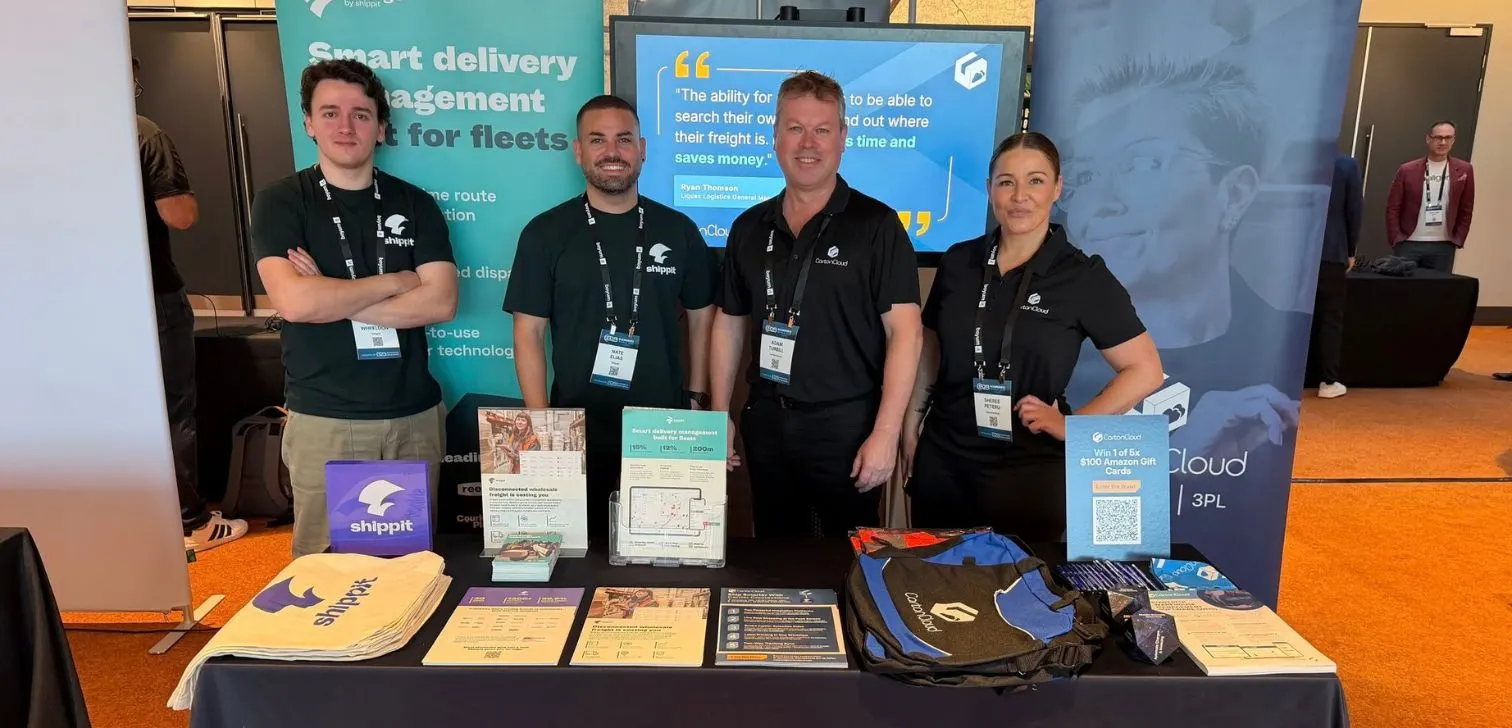
What We Heard at B2B World APAC: Large Brands Want Delivery Visibility, Not Just Warehouse Visibility
The Fastest WMS to Implement for E-Commerce Fulfillment 3PLs in the USA

This Week in Logistics: A Cost Rule Peak — Canada's Tariffs Go Live, FedEx Guarantees Your Duties, and Peak Season Surcharges Land
What's the Best WMS for Small 3PLs That Need an Easy Setup?

CartonCloud vs Extensiv: Which Platform Delivers More for 3PLs?

Get a Free, Honest Read on Your Operation, in About Two Minutes

CartonCloud’s Commitment to Security: SOC 2 Type 2 Audit Complete

How to Implement a WMS in Your Small 3PL Business: A Practical Guide
.webp)
This Week in Logistics: Multiple Warehouses, Multiple States, One Standard — How HD Warehousing Does It, With Special Guest Chad Hildebrandt, Owner & COO

August 2026: New Feature Round-Up
Warehouse Software for Cold Storage, Food, and Temperature-Controlled Logistics
This Week in Logistics: Season 2 Returns — US-Canada Tariffs, Oil Volatility, and Panama Canal Cuts All at Once