TWIL: When the System Says Forty and the Shelf Says Twelve — How to Close the Inventory Gap, With Special Guest Gaubrielle Pritchard, Director of Product and Customer Marketing
Shaun Hagen, CEO of CartonCloud, talks with Gaubrielle Pritchard, Director of Product and Customer Marketing at Cin7, about why inventory and warehouse systems drift apart, the four growth triggers that quietly break fulfilment, and what real visibility actually requires.
Published:
October 13, 2026
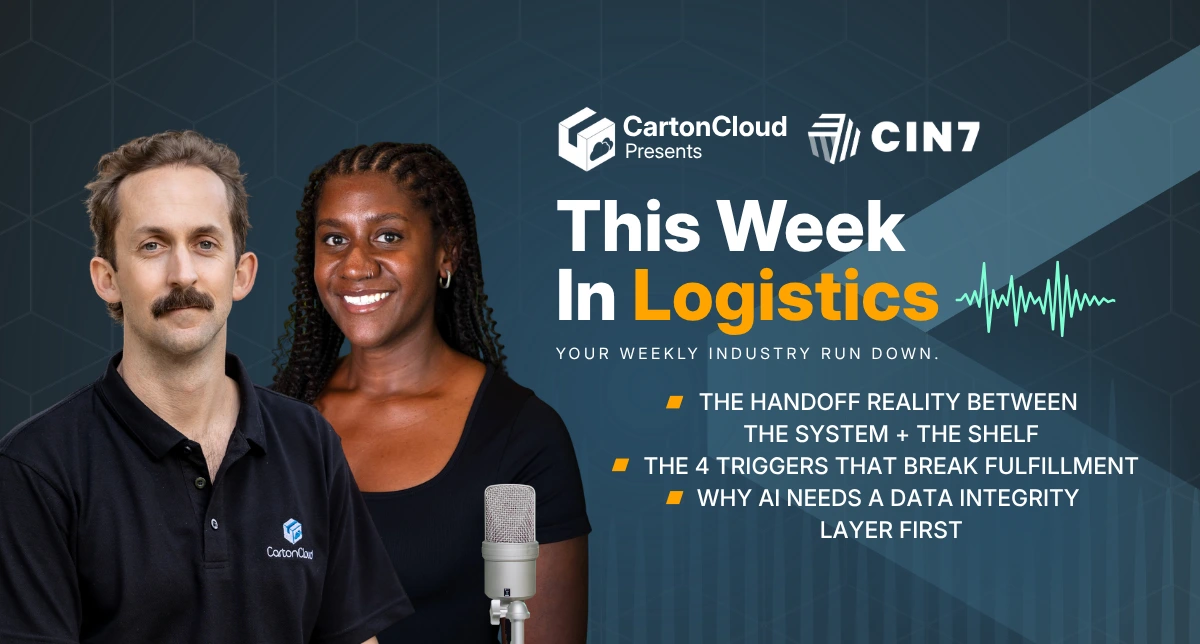
TABLE OF CONTENTS
The system says forty. The shelf says twelve. Both numbers were right once, and the real question is when they stopped agreeing. This episode of This Week in Logistics unpacks where that gap actually starts, the four growth triggers that quietly break fulfilment, and what operators actually need from a 3PL once stock leaves their own walls.
TL;DR — The short version, inventory accuracy lessons from Cin7
- Audit the handoff, not the warehouse. The gap between what a system says and what's on the shelf almost always lives in the connection between systems, not in picker error.
- Growth breaks fulfilment in four ways. Adding people, adding selling channels, reaching customers geographically, and rising costs each introduce a new point where the number stops matching reality.
- Visibility without data isn't enough to trust a 3PL relationship. Knowing what you're sending and how fast you need to send it matters as much as being able to see it happen.
- AI needs data integrity before it needs speed. A recommendation built on the wrong number just gets you to the wrong answer faster, with more confidence.
I'm Shaun Hagen, CEO of CartonCloud and host of This Week in Logistics. This season, we're shedding light on what actually happens behind the scenes of the operators and partners we work with, and this week it's a special deep dive with our partner Cin7. We're covering this topic because an inventory discrepancy is one of the most common, and costly, problems operators run into as they grow, and it rarely gets traced back to its actual cause until it's already cost someone money or a customer's trust. Gaubrielle Pritchard, Director of Product and Customer Marketing there, joined me for this discussion on where inventory truth actually breaks down, and what it takes to hold it together as a business grows. Let's get into it.
Where inventory truth actually starts to drift
Every operator has lived some version of the same moment: the system says one number, the physical count says another, and somewhere in between is a customer waiting on an order. It happens every day, and it tends to show up hardest heading into peak season, when the gap between what you think you have and what you actually have gets expensive fast. Most operators assume a discrepancy like that means someone miscounted. Gaubrielle's experience across e-commerce and fulfilment points somewhere else first.
"You see it a lot, in my opinion, start to drift as you start to bring in more touchpoints in your process. Another warehouse, maybe working with a 3PL, maybe doing drop shipping. And we also see it a lot with manual work." — Gaubrielle Pritchard, Director of Product and Customer Marketing, Cin7.
Once a business is relying on manual inputs with no checks and balances beyond someone's eyes on a spreadsheet, the gap can open immediately (and often silently). When the software they're running doesn't flag the discrepancy itself, operators are often the last to find out.
For me, this is where the real challenge sits, in the space between two records that are both technically correct.
"There can be two truths in the same box: what you own and what you sold, which is the commercial record, and then what's physically on the shelf, and where, and who's touched it. Both can be right, but the problem is when they stop agreeing, and that's exactly when the forty on the screen becomes the twelve on the shelf." — Shaun Hagen, CEO, CartonCloud.
It's also why the warehouse gets blamed for the gap more than it deserves. You can physically count a shelf. It's much harder to find where a sync went wrong, who keyed in an order incorrectly, or what piece of paper got misfiled.
The costs of a drifting number rarely show up as a line item, but they're real.
"That one horrible moment when all of a sudden you oversell by ten, or something gets lost in transit and you don't have that buffer stock, that's when you learn the hard truths." — Gaubrielle Pritchard, Director of Product and Customer Marketing, Cin7.
Returns, recounts, and buffer stock all go into cost. A recount is labour spent somewhere else. Buffer stock is cash sitting on a shelf. And the phone call explaining a short order is probably the most expensive one, because it spends trust rather than money.
The operator takeaway: before you audit your pickers, audit the connection between your inventory system and your warehouse system. The gap almost always lives in the handoff, not on the floor.
The four growth triggers that quietly break fulfilment
Most people assume growth pressure comes from adding SKUs. Gaubrielle's view, drawn from working with companies of all sizes, is that it rarely is.
"I've worked with dozens of companies that have fifteen SKUs and we all think, 'lucky them,' and it's just all over the place, because they don't take into account the other complex things it takes to scale and grow a business." — Gaubrielle Pritchard, Director of Product and Customer Marketing, Cin7.
She breaks the real pressure points into four categories:
- Adding people to the team. More hires means more permissions, more training, and less consistency in how the system gets used.
- Adding selling channels. Each new channel, especially wholesale, comes with its own rules and systems to reconcile.
- Reaching customers geographically. Expanding reach introduces international tariffs, delivery-time disadvantages, and the technicality of managing stock across multiple locations.
- Rising costs. Shipping, labour, and write-offs all climb as a business scales, and growth that isn't linear with cost is growth that erodes margin.
"Those are the four things someone gradually moves through, to where they start to say, 'I can't do this in a spreadsheet, I cannot do this in a program or software that doesn't have good uptime, or I'm losing count here or there.'" — Gaubrielle Pritchard, Director of Product and Customer Marketing, Cin7.
These four triggers are rarely sudden. They build quietly, and the breaking point usually gets crossed without anyone signing off on it, often surfacing hardest during peak demand, when there's no time left to fix it properly.
"It often becomes clear during a period of peak demand, when you're actually very poorly equipped to do anything about it. It's more about survival at that point. You probably want different systems and processes in place, but you can't make that change two weeks before Black Friday, Cyber Monday sales start rolling in. So you get through that survival mode, then you hit the second week in January and think, 'Well, actually, maybe it wasn't so bad, maybe we're quiet for the next couple of months, I'll defer,' and then you end up back in the same place." — Shaun Hagen, CEO, CartonCloud.
The operator takeaway: don't wait for peak season to find out which of these four you're exposed to. Walk through them now: check who has system access and whether permissions have kept pace with headcount, confirm every selling channel is actually reconciling back to one number, map where stock sits against where your customers are, and check your cost per order hasn't crept up without anyone noticing. Fix what you find while there's still time to act on it, not during the rush.
Visibility, data, + why AI needs both to work
Those four growth triggers are often exactly what pushes a brand to start looking at a 3PL. Handing fulfilment to someone else can solve a lot of the pressure, but it also introduces a new version of the same problem this episode opened on: once stock leaves your own site, you can't just walk out and check it yourself. For operators weighing up a 3PL, Gaubrielle points to one thing above everything else.
"The number one thing people want is visibility. What are you sending out? Did that tracking email for my customer go out? Was there an issue in transit?" — Gaubrielle Pritchard, Director of Product and Customer Marketing, Cin7.
But visibility on its own isn't the whole picture.
"People are looking for that visibility, but one thing they may not know is they also need the data to understand what they're sending, and the velocity they need to send it at." — Gaubrielle Pritchard, Director of Product and Customer Marketing, Cin7.
Without that data, a brand risks just transferring its existing problems to someone else's building rather than actually solving them. That same demand for trustworthy data is exactly what's driving how operators think about AI. Cin7's Denver Summit this year centred heavily on it, and Gaubrielle's take lines up with what we've been seeing across the industry: operators want AI, but they want to trust it first.
"They want to know that if you're offering a data point to help forecast for the future, or automate something, there's data integrity behind it, and that we're building tools to help solve a problem that's important." — Gaubrielle Pritchard, Director of Product and Customer Marketing, Cin7.
AI running on bad data doesn't give you a bad answer slowly, it gives you a confident wrong answer fast, and confidence is the part that makes it dangerous. Before you let any tool automate a decision, check the data integrity underneath it: is the number it's working from actually accurate, and does it update in real time, or is it running on yesterday's export? Get that right first, then let the tools do the rest.
"It does need to start with a bit of data accuracy and integrity up front, because AI running on the wrong data is just going to get you to the wrong answer faster, with more confidence, and that doesn't help anyone." — Shaun Hagen, CEO, CartonCloud.
The operator takeaway: before you invest in anything with AI on the label, ask one question first: what data is it actually using? If it's pulling from a number your team already knows is shaky, or an export that only updates once a day, fix that before you automate anything on top of it.
How Cin7 + CartonCloud fit together
Everything we've covered, the drift between two truths in the same box, the four growth triggers, the visibility a 3PL needs to actually deliver, comes back to the same handoff: the point where inventory stops being a number on a screen and becomes stock moving through a warehouse. That handoff, where stock leaves a brand's own site, is exactly where I see Cin7 and CartonCloud lining up.
"Cin7's obviously the commercial record — it does a great job managing inventory, orders, channels, and really solves that data piece, as well as managing the warehouse piece. I think what happens in that next phase, where the warehouse gets more complicated, that's where we see that change come in. It's not really an inventory problem anymore, it's a warehousing, execution and workflow problem. So whether that's in-house or with a 3PL, it's been exciting for us to work together and solve that." — Shaun Hagen, CEO, CartonCloud.
The operator takeaway: if you're already running Cin7 and your warehouse has outgrown what a commerce platform can manage on its own, that's the signal to add a dedicated execution layer, not another manual workaround. CartonCloud sits underneath Cin7 for scanning, pick paths, and dispatch, whether that warehouse is run in-house or by a 3PL, so inventory and warehouse keep agreeing without anyone keying numbers between systems by hand.
What operators can take from this conversation
- Audit the handoff before you audit your pickers. The gap usually lives in the connection between systems, not on the floor.
- Watch for the four growth triggers, people, channels, geography, and cost, since each one quietly raises the chance of a discrepancy.
- Visibility and data go hand in hand. Knowing what you're sending matters as much as being able to see it happen.
- Get the data right before you trust the AI. A confident answer built on a wrong number is still a wrong answer.
If you're already on Cin7 and want to see how the warehouse execution layer fits in, find out more about the Cin7 and CartonCloud partnership.
FAQ
Q: Why does inventory truth drift between an inventory system and a warehouse?
A: Inventory truth drifts because the commercial record, what's been ordered and sold, and the physical warehouse record, what's actually on the shelf, are tracked separately and only agree until a sync breaks down, a manual entry is missed, or a new touchpoint like a 3PL or drop-shipping partner is added.
Q: What are the four growth triggers that break fulfilment?
A: The four growth triggers are adding people to the team, adding selling channels, reaching customers geographically, and rising costs. Each introduces a new point where systems and processes can stop keeping pace with the business.
Q: What should operators look for in a 3PL relationship?
A: Operators should look for genuine visibility into what's being sent and when, backed by the underlying data on inventory and shipping velocity, not just a dashboard. Without that data, a 3PL relationship can end up transferring existing problems rather than solving them.
Q: Why does AI need data integrity before speed?
A: AI needs data integrity first because a forecast or recommendation built on inaccurate data produces a confident wrong answer faster than a human would have. Fixing the underlying data is what makes the AI output trustworthy.
Q: How do Cin7 and CartonCloud work together?
A: Cin7 manages inventory, orders, and channels as the commercial record for a brand. CartonCloud adds the warehouse execution layer, covering scanning, pick paths, and dispatch, for Cin7 customers who need more from their warehouse operations without changing how they run inventory in Cin7.
Post by Shaun Hagen, CEO CartonCloud.
Gaubrielle Pritchard: Once you start to feel a little pinch of 'wow, this is manual,' or 'I have five spreadsheets,' or 'I didn't check last night, I have to check this morning' — that's when you should start thinking, okay, the stress is coming. And that one horrible moment when all of a sudden you oversell by ten, or something gets lost in transit and you don't have that buffer stock — that's when you learn the hard truths.
Shaun Hagen: I think the real challenge is that there can be two truths in the same box: what you own and what you sold, which is the commercial record, and then what's physically on the shelf, and where, and who's touched it. The problem is when they stop agreeing — and that's exactly when the forty on the screen becomes the twelve on the shelf.
Shaun Hagen: Now, as you know, I'm always excited when I get to have a wonderful guest on. So today I'm joined by Gaubrielle Pritchard, who's the Director of Product and Customer Marketing at Cin7. Gaubrielle, welcome to the show. How are you going today?
Gaubrielle Pritchard: Hi Shaun, I'm doing fantastic. So excited to be doing this session with you and talking about my favorite subject, e-commerce and fulfillment.
Shaun Hagen: We did do a prep call, and I can attest that that is the truth. I'm really excited for today's conversation, and we'll do our best to stick to the time guidelines, but we'll see where we get to. Now, before we get into it, I'd love for you to give people a bit of a sense of where you've actually sat in this world of e-commerce, logistics and fulfillment. You've been in this industry for a very long time, and not just on the software side.
Gaubrielle Pritchard: Yeah, so I've worked in this space for about 12 years — e-commerce, inventory management, fulfillment, even reputation management. So kind of the full gamut. I got my start in sales, did a lot of onboarding, implementation, things like that, and kind of became a product evangelist. I started becoming friends with product people, engineers, and just wanting to learn more about how to release great products and how I should talk about them to sell and make more money. And that led to my road into product marketing. We always joke, no one really goes into product marketing, you just find yourself there. I've been working in the Austin area for most of my professional life, so I really love it here — the tech scene is amazing and there's such a great community to learn more about these different tools. And coming into Cin7 earlier this year, I've had a lot of exposure to inventory management. So it's great to be at an amazing company whose main focus is ensuring that our customers have the right products in the right place, and we solve for as many headaches as possible to make your life a lot easier.
Shaun Hagen: Absolutely. And I can speak from firsthand experience that when you have someone who's ended up in that product marketing instance and they're fantastic, you're very lucky to have them. So very proud for you joining the Cin7 team, and I look forward to seeing what you get up to there. But as you said, today we're here to talk about something very close to both of our hearts — unfortunately not always in a good way. Very close to the heart of our operators, but often in a heartbreaking way. That's really the scenario when things start to break down between systems. The example I had is when the system says forty and the rack says twelve. I'm guessing you've heard a few versions of that discrepancy between what a system says and what the actual physical count says.
Gaubrielle Pritchard: Yes, people see it every day, especially as you're jumping from maybe spreadsheets, or you're already using an inventory management solution paired with a warehouse management solution. Sometimes you've just got to walk into the warehouse and see what's actually there. But what happens when you're not close to the warehouse? Or what happens when you have multiple warehouses and you have those discrepancies? We come across it every day, especially as we're coming into peak season, when people are trying to fortify their systems. Not having that line-up is not only a headache for yourself, but for your customer and that customer experience. And there's nothing worse than having to make that call, or firing off that email saying, "Hey, not only do we have it, it's going to take us a week to get it. I hope you understand."
Shaun Hagen: Absolutely. I think we've all, as consumers, been on the other end of that. And I'd like to think that you and I are probably a little bit more gracious with that message than others, given that we can certainly understand how the best-laid plans—
Gaubrielle Pritchard: Yes, I can — yes.
Shaun Hagen: But yeah, as you say, we're heading into the sort of peak demand period as we run up towards the end of the year. And one thing we'll probably touch on a few times is I think this particular year presents additional challenges for operators, because it's not just a peak demand period, it's also a peak period of uncertainty and cost.
Gaubrielle Pritchard: Mm-hmm.
Shaun Hagen: So I think those lessons will be even more true this year, especially for the US base — US-based operators who have a bit of uncertainty on either side of their major trade partners. So it'll be interesting to see how that plays out for operators this year. Now, obviously, between the two of us, we sit at a really interesting cross-section of this. From the Cin7 perspective, obviously very close with brands and distributors, managing their own inventory, orders and channels. Typically, from our perspective, we sit on the warehouse, fulfillment, transport side — either within a brand's own operation, or on the 3PL side, as you said. And that can be one of those opportunities where there can be discrepancies that you can't just walk out and check. So maybe if we can go into that — where do you actually see that inventory truth starting to drift in an operation?
Gaubrielle Pritchard: Yeah, you see it a lot, in my opinion, start to drift as you start to bring in more touchpoints in your process. Another warehouse, maybe working with a 3PL, maybe doing drop shipping. And we also see it a lot with manual work. When you start to have a day where you think you're just doing manual inputs all day, every day, you're already at a disadvantage. You're already at a place where you could start to have discrepancies immediately, just because there are no checks and balances other than your eyes looking at a spreadsheet or your eyes looking at a screen. And there are a lot of softwares out there, including ours, where we try to make sure that if there is a discrepancy, you know about it — but some don't. And so you don't know until you don't know, and then you're submitting that ticket and being told, "We're working on it, we're so sorry." It really starts to crumble because when someone goes into a business, the last thing people are thinking about is tracking inventory or fulfillment. It's the least sexy part of the job. They really want to say, "Let's make my website, I want to create cool products," and they just want to make sure it gets to the customer. But what do you actually have to do to have a successful business — to get it out, and to ensure that even if it comes back, because returns management is also something people don't realize is such a heavy piece of the e-commerce and fulfillment space in general. I should know, I'm a return monster — I'm so sorry to anyone I've ever bought anything from, I'm getting better. But not everyone's going to do it. And once you start to feel a little pinch of "wow, this is manual," or "I have five spreadsheets," or "I didn't check last night, I have to check this morning" — that's when you should start thinking, okay, the stress is coming. And that one horrible moment when all of a sudden you oversell by ten, or something gets lost in transit and you don't have that buffer stock — that's when you learn the hard truths. And we're here to help you see how you can address those sooner rather than later.
Shaun Hagen: Absolutely. And buffer stock's a really good one, because it ties back into that cost pressure — that's an expense to the business, needing to run buffer stock because your systems and processes don't necessarily give you the certainty to run at a lower threshold. But someone has to pay for that. It takes up space in a warehouse that someone's paying for. Someone has to count it. Someone's got to work out if that's a discount sale, if there's too much. That just adds to the headache when things break down. And I think what we often see — whether that's in-house or a 3PL — is that it's very often the warehouse that gets blamed first, because it's the easiest. You can physically count a shelf. It's much, much harder, as you mentioned, to find where a sync went wrong — who keyed in an order incorrectly, or what piece of paper got misfiled. But I think the real challenge is that there can be two truths in the same box: what you own and what you sold, which is the commercial record, and then what's physically on the shelf, and where, and who's touched it. Both can be right, but the problem is when they stop agreeing — and that's exactly when the forty on the screen becomes the twelve on the shelf. And returns, recounts, buffer stock — that all goes into cost.
Gaubrielle Pritchard: And even in importing stock — I think that's a really interesting point, where the front of the house and back of the house... fun fact, I do have a culinary background, so you'll be hearing a lot of cooking lingo and jargon.
Gaubrielle Pritchard: But that's where the front of the house, your home office that's actually placing the order, and your warehouse that's accepting it — that's also a really important handoff. Did that box stay sitting in the corner? Did you actually key it in? Or I just wasn't looking fast enough when I'm taking a wholesale order — those are things to also be cognizant of.
Shaun Hagen: Yeah, and that's it. The gap exists in that handoff between front of house and back of house — I love that phrase, I love that terminology. And I think that's obviously a pain point we see a lot: is that connection really strong between the systems, and also the processes there? Now, I guess moving on to some of the scenarios where growth — especially moving into this peak period — where that growth starts to break things, because that can obviously be one of the key changes a business goes through, is that it starts to put pressure on the fulfillment process. Most people typically think about that in terms of order volumes and SKUs, but I really love the way you phrased this on our prep call — that you see that tipping point emerge in a business across four categories. Can you walk us through where you see that growth start to put pressure, or how a business can actually grow to reach that breaking point?
Gaubrielle Pritchard: For sure. And I agree — a lot of people think that adding SKUs or different products is where the complexity comes in. But I've worked with dozens of companies that have fifteen SKUs and we all think, "lucky them," and it's just all over the place, because they don't take into account the other complex things it takes to scale and grow a business. If you have few SKUs, you think, "let's just take off." But I put growth into four categories, to help people think about these silent triggers that will cause quite a headache. The first one I'd say is adding people to your team. Are you starting small and it's just you and your family, but then you employ friends, but then you actually employ real employees? Adding people adds more cooks to the kitchen — it's also more permissions, making sure people understand the software, and bringing on people who have different experience with different programs or ways of working. So that's more ways of training, but also less eyes on everything, especially as a business owner or starter business. Another one everyone's pretty familiar with is adding selling channels. I started with my website — do I want to add Amazon, eBay, Walmart? Do I want a secondary website brand? Do I want to start selling wholesale, which is another beast in itself, with a lot of rules, regulations, and working with larger wholesalers and retailers that have their own slew of requirements and systems you're required to work with? So that's the second one — and also understanding where you want your sales to come from. Amazon's obviously a bigger channel, but people also want to grow their brand, get recognition, get that direct traffic. So where do you put your investment, and how fast do you grow? The third one is reaching a wider set of customers geographically. That's when you start to introduce international — as you mentioned, tariffs. A couple of years ago, when we were going through changes in the US, we'd see a lot of people start to look at using 3PLs because they had the relationship, so they weren't getting their stuff caught at the border and then having to tell a customer, "I'm so sorry, your duties and taxes are going to be 80% of the cost of your package." That's not a great conversation to have. And another side of adding things geographically is people want their stuff faster. Again, I'm sorry to anyone I've ever bought something from, because I want it fast too, but people want it there faster. What that brings up is: if you're selling in Chicago, you're pretty good for the US, but you start to get a disadvantage the further out you go. If you're selling in New York, you've got the two-day lock-on for the East Coast, but going to the West Coast, that's four or five days. So that introduces either partnerships you can leverage for warehouse space, drop shipping, 3PL, or an even bigger undertaking — opening your own warehouse in multiple places. And that, again, with the visibility of seeing what's over here versus over there, brings a lot more technicality to your process. And I'd say the fourth one is rising costs in general. We saw the massive boom of e-commerce shipping and fulfillment coming out of COVID, because everyone was home, and that carried in a huge investment. But we also see the cost of shipping things from anywhere going up and rising all the time, especially with oil prices up and things like that. So when people start to see those rising costs, you want your sales to go up, but you don't want your growth to be linear — "I am selling more, therefore I am shipping more, therefore my shipping costs are going up." So not only how can you save money through time, but also save money through shipping costs, labour in your warehouses, and cutting down on write-offs — that package you lost in transit, or whatever. So I'd say those are the four things someone gradually moves through, to where they start to say, "I can't do this in a spreadsheet, I cannot do this in a program or software that doesn't have good uptime, or I'm losing count here or there." And it's also a way for people to start strategising from a business standpoint — how do I continue to grow and scale, and who do I need on my team to do that? Is that a procurement manager? A very specific title I need to have? Is this a warehouse manager, and specifically someone who handles my returns and my wholesale? Those are all questions that programs like this are amazing for, to help figure out what stage you're at, and what your options are to alleviate a lot of those headaches.
Shaun Hagen: Absolutely. I think one thing I've seen over the years is that some of those things happen silently in the background. It's not always clear when you've reached that breaking point. And it often becomes clear during a period of peak demand, when you're actually very poorly equipped to do anything about it — it's more about survival at that point. You probably want different systems and processes in place, but you can't make that change two weeks before Black Friday, Cyber Monday sales start rolling in. So you get through that survival mode, then you hit the second week in January and think, "Well, actually, maybe it wasn't so bad, maybe we're quiet for the next couple of months, I'll defer" — and then you end up back in the same place. Because there's not always a single breaking point. Sometimes there is, but often there's not.
Gaubrielle Pritchard: Yes.
Shaun Hagen: And then you get back into October and say, "I swore I would never do this again," and then that—
Gaubrielle Pritchard: Wait a minute, why was my reflection period twenty minutes? Why did I not listen to that tiny voice in my head? Absolutely.
Shaun Hagen: I understand, and that's a hard point. I think you raised some really good points that we see from the 3PL side a little, but even from people managing their own warehouse, where some of these brands want to just focus on building their website, growing their business, making sales and marketing and positioning and pricing strategy decisions — and not necessarily seeing fulfillment as a distraction. Some see it as a differentiator — a point where they can ensure the customer experience is the way they want it to be. And like you said, geographic coverage becomes another part of that. I think that international tariff management piece is another really good example of where a 3PL can fit in. It's easy to see a 3PL as a cost for something you could do yourself when you come from doing it yourself — but sometimes that's not true, once you count the opportunity cost, or the scaling or service cost. It can be a compelling alternative, however you structure that fulfillment. But I think, from your experience, a lot of brands hit that point — maybe on the 3PL angle specifically — where do you see that going well? And where do you see issues coming up in that process of moving to a 3PL?
Gaubrielle Pritchard: Yeah, so 3PLs — I think they're super handy. I've worked directly with quite a few of them, and also built software around communicating with 3PLs. The number one thing people want is visibility. What are you sending out? Did that tracking email for my customer go out? Was there an issue in transit? Ensuring they're sending enough stock to the 3PL so it can be handled. And working with different vendors and different types of software — how does that communication happen? And also the manual part of it — if you're sending off something, or creating any type of documentation, how can I automate this? How can I get my life outside of emails and phone calls all the time, and streamline that? And then it really boils down to data — knowing, from that perspective, getting a little reassurance from a 3PL if you're starting out. Do you want to send all your inventory, or just your top SKUs? Do you know what your top SKUs and sales velocity look like, so these companies can do a good job for you? So people are looking for that visibility, but one thing they may not know is they also need the data to understand what they're sending, and the velocity they need to send it at — to ensure that not only are you trying to iron out your existing issues by bringing on a 3PL, you're not just transferring those problems onto someone else and saying, "Well, you've got it now, just let us know if anything happens." It's about trying to get a little ahead of the game as far as having that visibility.
Shaun Hagen: Yeah, absolutely. I think putting yourself in a position to be a good client of a 3PL can be a big cost-saving advantage, because the more things can go well and you can plan for that, the better you can manage it. So if you run a 3PL, I think the interesting insight from what you've shared is that those four categories you ran through are the exact moments your prospects are ready to talk to you to help solve their problems — teams growing, adding wholesale, whatever it looks like, geographic coverage, costs. I think the key concern for them is losing that visibility and control once the stock leaves their physical site, whether that's partial or full. And I think that's one of the main objections to solve — and it's often a systems problem, not a sales answer. And selfishly, I think that's where Cin7 and CartonCloud have focused on fitting together. We've worked together in various workflows, whether that's 3PL fulfillment or managing your own warehouse. I think Cin7's obviously the commercial record — does a great job managing inventory, orders, channels, and really solves that data piece, as well as managing the warehouse piece. And I think what happens in that next phase, where the warehouse gets more complicated — that's where we see that change come in. That's obviously where we often find ourselves working together, because it's not really an inventory problem anymore, it's a warehousing, execution and workflow problem alongside that. So whether that's in-house or with a 3PL, it's been exciting for us to work together and solve that.
Gaubrielle Pritchard: Totally.
Shaun Hagen: But it's a real problem, and there are obviously other challenges and other solutions out there too. I think the question's the same: does my inventory system and the warehouse system agree, without a human or a spreadsheet in the middle? Because if there's something in the middle, you've just transferred your problem to something else.
Gaubrielle Pritchard: Yeah, and when the systems work well together — I mean, why not dive in? That's how I feel about our two systems.
Shaun Hagen: Yeah.
Gaubrielle Pritchard: For sure.
Shaun Hagen: Absolutely. Now, probably the last chunk I was keen to jump into — Cin7 actually ran its Summit event in Denver last month, under the theme "The Future in Stock." I was only down there for a couple of days, unfortunately, due to some appointments back in Vancouver, but you were there for the whole event. What were the key themes from your perspective that kept coming up during that Summit?
Gaubrielle Pritchard: Yeah, the Summit was great — it's our annual flagship event. It was fantastic that I joined at a time when I could actually attend.
Shaun Hagen: Absolutely.
Gaubrielle Pritchard: It was just a huge production, and it even helped with this session too. I think the big one — and it's in the name as well — was the idea of AI. Where's that innovation coming from? I think AI is interesting, because people — and I say this from a product marketing lens — want AI, but they want to understand and know that it's truthful. They want to know that if you're offering a data point to help forecast for the future, or automate something, there's data integrity behind it, and that we're building tools to help solve a problem that's important, even if you don't yet know it's a problem. Because in the age of AI slop, there's just so much volume — we want to be really intentional. So we wanted to get in front of our customers and partners and talk about that. We also wanted to talk about building better partnerships — it's such a big partnership event, which I'd never experienced before. Everyone was friends, everyone wanted to work together, and it was such a positive experience. Finding ways to connect to our customers to ensure we're offering the best services and software that work together for the benefit of our users. And then I'd also say another thing was jumping into the future — what are we looking to accomplish from an inventory management standpoint, becoming a very AI-driven platform, and how do we ensure every part of your team can benefit from this? Because a lot of the time, when we think of inventory management right now, AI can say, "let's run some reports," and maybe everyone in the home office benefits. But how can your warehouse benefit? How can making sure you're using a great WMS and other features ensure that we're solving for those problems you might think are a little annoying right now, but could get annoying really fast? Let's bring that to the forefront.
Shaun Hagen: Absolutely, and it was a great event — well done to you and the team for putting it on. On AI specifically, I'm interested — from your perspective, sitting here in Q3/Q4 2026, where do you see it as real for operators today, and where is it still kind of a promise? We've talked about this a few times on the show — for a lot of the people we speak to in the industry, the AI that probably matters most right now is the boring kind, but it's actually solving a real-world problem. It's helping them with something — flagging exceptions before a phone call, cleaning up data. I'm keen to hear, from the Summit and your own experience, where is that real for an operator today, and where is it still a promise — and where do you think that's going?
Gaubrielle Pritchard: Yeah, one thing I'm really passionate about is that with a lot of software, some people think onboarding, or using something a bit more advanced, is a barrier to entry. For us, we want to make sure we're leveraging AI so you can get up and running as quickly as possible, in a way that makes sense for you. So using a lot of natural language processing so you can ask questions, whether that's with our tool called AMA, where you can ask questions and get answers, through to features we're thinking about. For instance, when you think of rules and workflows — someone coming from a spreadsheet says, "every morning I need to export this report," or "if an order comes in like this, I want to treat the inventory like that," or "if a return comes in, whatever it may be." A lot of people are living in this if-then state, versus just wanting to type out what they're thinking. If you've never used something this advanced, why not just type what you're thinking, and we figure out those workflows for you? Or we can actually see, from a shipping standpoint, how you're shipping and how you can optimize, whether that's carrier management or something like that. Those are the things we're trying to express, outside of just the data set and outside of chatting with a chatbot. How can we make it easy for you to get going from day one, get great information, and continue to use that through the lifetime of your use with us? And we also have the history to back it up, and the data to ensure you're on the right track and in line with your goals as a business. That's how we want to expand it, and again, we want data integrity, we want to be truthful. I can't wait for a lot of things we're building out and conceptualising from the team and launching. A great one I'll call out is our ForeSight AI, which looks at smart reorder and forecasting in general. No one wants to live in purchase orders and spreadsheets. So if you can get a great recommendation, and we tell you why we recommended it, you're feeling good about the recommendation — and again, how integral that data is — and then sending that off to your suppliers, that's saving you hours. So those are things we're working on now, and things we're working on in the future, to ensure everyone can have a streamlined process, no matter where they are in their journey as a business owner in e-commerce and wholesale.
Shaun Hagen: Yeah, and I couldn't agree more with everything you said. I think one of the reasons we've enjoyed working with Cin7 is we have a very similar view on the role for AI to play. And I think it's often skipped, but it does need to start with a bit of data accuracy and integrity up front, because AI running on the wrong data is just going to get you to the wrong answer faster, with more confidence — and that doesn't help anyone. But it is so powerful, and it can unlock hours back in the day, or enable you to make better decisions than you might have made in isolation. But building that trust is so important, because it's not that long ago that you'd ask the same question twice and get two very different answers. That's not what you want in a supply chain and execution setting. That might be okay in some of the personal uses of AI, where the stakes are a bit lower.
Gaubrielle Pritchard: Yeah. Yeah.
Shaun Hagen: But no — in supply chain, I think you need that predictability and certainty, and that's obviously on us to make sure our customers and users get that. But forecasting exceptions, even just managing and cleaning up data — there's so much potential in just those applications now. And as you said, starting to provide insights into people's businesses in the future that help them get access to information they didn't have, or couldn't have had on their own, is where it starts to get really exciting.
So the last one for me, Gaubrielle — maybe a message of hope. For a business that gets everything connected properly — inventory, orders, warehouse all agreeing — what actually changes day to day, and what can that look like for them?
Gaubrielle Pritchard: Yeah, some people say "happy wife, happy life" — I don't have a quippy one for staff, but happy staff means everyone's just happy in general. When someone can take a deep breath at the end of the day and say, "I feel confident my job is going smoothly," there's power in that. You're not going to grow and scale by yourself — you have to have an amazing team. And when you listen to what your team needs and implement processes to make their life better, not only are they happier and want to come to work, but it also frees up your mind to actually start to strategize, brainstorm, build connections, and figure out where you want to take the business. How can we make it better — not just how can we survive in that survival mode, but how can we actually see growth work in tandem with having a positive workspace? I wholeheartedly believe that when you set up systems that work together, when you take a moment to think about how you can streamline your process in a way that works best for you and your customers, everyone benefits from that — it's a whole downstream effect. So we're always keen to help, I know you're always keen to help, and I can say that for myself — when you're happy at work, you actually feel like you want to do the work.
Shaun Hagen: Absolutely. I think, as you absolutely nailed, there are a few advantages here. But when you do get that all working seamlessly together, I agree — I don't know any of our customers or mutual customers who've achieved that and still have staffing challenges. It helps relieve that. Everyone's happier, customers are happier. I'll take it as homework to try to come up with a restaurant analogy.
Shaun Hagen: A restaurant analogy that you can use — that can be my gift to you. Thank you, you've said it all, Gaubrielle. It's been a pleasure having you on. Thank you very much for coming on and bringing your really unique and valuable perspective to this. For anyone who wants to find out more about Cin7, and all the work we're doing together, we'll post a few links in the show notes, and you guys can reach out. But that's it for this week in logistics — for this week, we'll leave it there, and we'll see you next time.
Gaubrielle Pritchard: Thank you so much, Shaun.
Explore the resource hub
Tips, tools, downloadable guides and stories from logistics teams who are working smarter.
.webp)
The CartonCloud Logistics Index 2026: See where your operation stands

Running WMS and TMS Across Multiple Sites in Australia: The Questions We Answered at MegaTrans 2026
CartonCloud Feature Spotlight: July–September 2026
Deposco Alternatives: What Growing 3PLs Should Consider
What We Heard at B2B World APAC: Large Brands Want Delivery Visibility, Not Just Warehouse Visibility
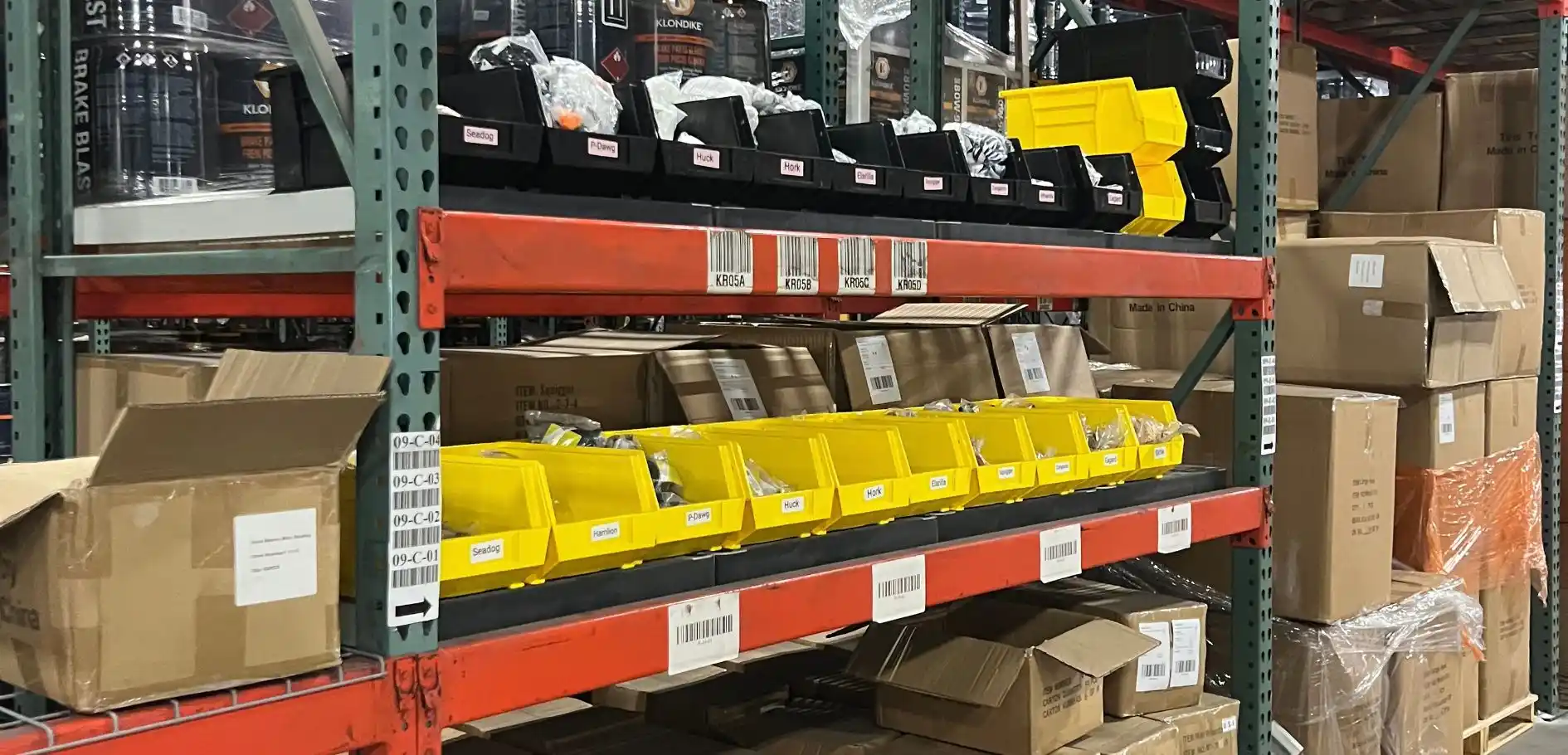
The Fastest WMS to Implement for E-Commerce Fulfillment 3PLs in the USA
This Week in Logistics: A Cost Rule Peak — Canada's Tariffs Go Live, FedEx Guarantees Your Duties, and Peak Season Surcharges Land
What's the Best WMS for Small 3PLs That Need an Easy Setup?

CartonCloud vs Extensiv: Which Platform Delivers More for 3PLs?

Get a Free, Honest Read on Your Operation, in About Two Minutes

CartonCloud’s Commitment to Security: SOC 2 Type 2 Audit Complete
How to Implement a WMS in Your Small 3PL Business: A Practical Guide
.webp)
This Week in Logistics: Multiple Warehouses, Multiple States, One Standard — How HD Warehousing Does It, With Special Guest Chad Hildebrandt, Owner & COO
August 2026: New Feature Round-Up
Warehouse Software for Cold Storage, Food, and Temperature-Controlled Logistics
This Week in Logistics: Season 2 Returns — US-Canada Tariffs, Oil Volatility, and Panama Canal Cuts All at Once
.webp)
How Do You Know You've Outgrown Basic Warehouse Systems? 7 Signs for Growing US 3PLs
.webp)
CartonCloud Named a 2026 "Great Supply Chain Partner" by SupplyChainBrain
.webp)
Dock Management: How We Built Visibility Into Every Delivery
.webp)
July 2026 — New Feature Round-up